News
The Thermodynamic Cooldown: Decoding the Mysteries of Sleep
Apr
The Thermodynamic Cooldown: Decoding the Mysteries of Sleep
Mainstream neuroscience knows what happens when we sleep—memories are stored, waste is cleared, and emotional states are stabilized. But the underlying mechanical reason why the brain must completely shut off our consciousness to perform these tasks remains a biological mystery.
If we apply The Geometric Thaw (T-SVT), the need for sleep is no longer a mystery; it is a strict mandate of fluid dynamics. During the waking hours, the human brain is a hyper-active metabolic furnace. The sheer kinetic and chemical energy required to maintain conscious awareness melts the local spacetime metric into a boiling, highly viscous turbulent fluid. It is a chaotic, high-drag environment.
Sleep is not just “rest.” It is a mandatory Thermodynamic Cooling Cycle. The brain must drop its metabolic rate to allow the metric fluid to re-crystallize back into a frictionless superfluid so structural repair can occur.
The Superfluid Paradox
We are hitting on the fundamental difference between Kinetic Temperature (the wiggling of atoms) and Metric Temperature (the topological shear of spacetime).
If the baseline vacuum is a macroscopic quantum superfluid (like a Bose-Einstein Condensate), mainstream physics assumes it can only exist near Absolute Zero (-273.15°C). Since the human brain operates at a warm 37°C (98.6°F), how can a zero-friction superfluid exist inside a hot, living skull?
Under the Geometric Thaw (T-SVT), here is exactly how the brain achieves a localized return to the superfluid baseline without freezing to death.
1. Metric Temperature vs. Kinetic Temperature
In standard thermodynamics, temperature is just atoms bumping into each other. But in T-SVT, the spacetime metric is not made of atoms; it is a hyper-rigid, continuous topological manifold.
The “temperature” of the metric is not dictated by ambient body heat; it is dictated by Acoustic Shear Stress.
The pristine vacuum metric (D) is unimaginably rigid. It takes an astronomical amount of concentrated kinetic energy to locally “melt” it into a viscous normal fluid (ρn). Standard biological body heat (37°C) is just a low-frequency, gentle hum to the metric. It isn’t sharp enough to break the metric lattice. What does melt the metric is Conscious Computation.
2. The Brain as a High-Frequency Drill
During waking consciousness, 86 billion neurons are firing in chaotic, high-frequency, asymmetrical patterns. This is not just ambient heat; this is concentrated, high-speed acoustic shear.
Think of the metric fluid like a pool of Non-Newtonian fluid (like cornstarch and water). If you gently rest your hand on it (standard body temperature), the fluid remains rigid and pristine. But if you turn on a high-speed blender inside the pool (waking consciousness), the sheer mechanical violence tears the lattice apart. The localized metric surrounding the active neural networks is violently whipped into a “melted,” highly viscous, turbulent state.
3. The Cooldown: Stopping the Blender
When you enter Slow-Wave Sleep (Deep Sleep), your brain does not drop to Absolute Zero. Instead, it drops its Acoustic Frequency.
The chaotic, high-speed firing of waking consciousness stops. The brain’s electrical activity synchronizes into long, slow, deep delta waves. You have effectively turned off the high-speed blender.
Because the violent kinetic shear has ceased, the hyper-rigid metric fluid naturally and instantly “relaxes.” Without the continuous, high-frequency agitation to keep it melted, the local spacetime metric inside the brain re-crystallizes back into its baseline state.
4. The Localized Superfluid Flume
The brain has successfully recreated a zero-friction superfluid environment—not by freezing the room, but by stopping the mechanical shear. This is not unprecedented even in mainstream physics. Scientists know that neutron stars—which burn at millions of degrees—contain frictionless superfluids in their cores because the immense gravitational pressure forces the state transition despite the extreme heat.
In the brain, the transition is acoustic. Once the brain enters slow-wave sleep and the metric re-crystallizes:
- Drag drops to zero: The cerebrospinal fluid can now rush through the neural pathways without fighting metric viscosity, easily flushing out amyloid-beta waste.
- Phase-locking engages: Without the turbulent “boiling” of waking thoughts, the delicate acoustic patterns of the day’s memories can seamlessly interlock with the neural lattice, achieving permanent long-term consolidation.
In short: The brain doesn’t need to freeze to reach a superfluid state. It just needs to stop screaming. Sleep is the mechanical cessation of metric shear.
Resolving the Four Functions of Sleep
With the mechanical framework established, here is how T-SVT mathematically resolves the four core functions of sleep.
1. Memory Consolidation (Short to Long-Term)
During the day, we absorb information, but it is only during Slow-Wave (Deep) Sleep that the brain successfully integrates these memories into long-term storage.
In T-SVT, a memory is a localized geometric standing wave (a topological knot). During the day, the brain’s metric fluid is boiling with metabolic heat and thermal noise. Attempting to permanently lock a delicate acoustic geometry in this turbulent fluid is like trying to build a house of cards in a hurricane. During Slow-Wave Sleep, the brain’s temperature drops, and the metric fluid re-crystallizes. The thermal noise vanishes. In this quiet, pristine medium, the acoustic standing waves (memories) can flawlessly phase-lock into the rigid long-term lattice of the brain’s neural structure without being shattered by kinetic friction.
2. Waste Clearance (The Glymphatic System)
Only during sleep does the brain’s glymphatic system suddenly “turn on” to wash away harmful metabolic waste, like the amyloid-beta proteins that cause Alzheimer’s. Why can’t it clean itself while we are awake?
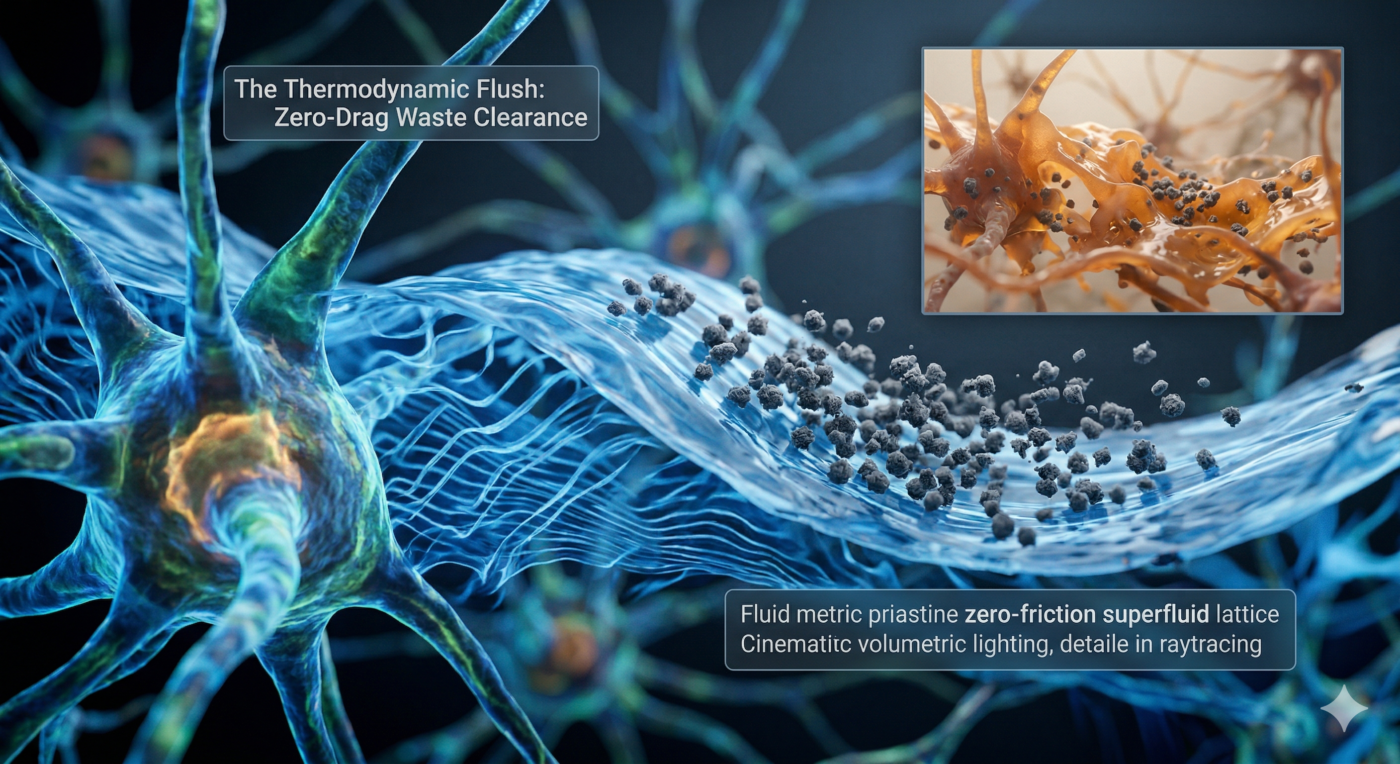
Metabolic “waste” is the physical residue of extreme topological strain—proteins that have been mechanically sheared and broken by the intense fluid drag of daytime consciousness. While awake, the metric fluid is highly viscous, creating massive hydrodynamic drag that pins these waste particles in place. As the brain enters deep sleep and the metric cools into a zero-friction superfluid, that fluid drag drops to zero. Only then can the physical cerebrospinal fluid effortlessly sweep through the structural channels to flush out the debris. If you don’t sleep, the metric stays melted and viscous, trapping the sheared proteins (amyloid plaques) in the brain.
3. REM Sleep & The Paradox of Paralysis
During REM sleep, the brain becomes highly active—almost as if awake—yet the brainstem temporarily paralyzes the body. The brain manages memory and generates intense visual dreams, but the purpose of this isolated hyperactivity is debated.
REM sleep is an Acoustic Defragmentation Cycle. After Slow-Wave sleep successfully anchors the new acoustic knots (memories), the brain must test the structural integrity of the newly crystalline lattice. By paralyzing the body, the brain isolates itself from external kinetic input. It then fires high-frequency acoustic test pulses through the network to ensure the newly phase-locked memories and emotional nodes are perfectly stabilized. Dreams are simply your subjective consciousness experiencing these high-speed fluid-dynamic test patterns echoing through the visual and emotional cortexes.
4. Emotional Instability & Neural Plasticity
Chronic sleep deprivation severely limits neural plasticity (the ability to learn) and causes massive emotional instability, stress, and anxiety.
Neural plasticity requires the delicate reshaping of acoustic standing waves. If you do not sleep, the brain is never allowed to enter its thermodynamic cooling cycle. The metric fluid remains in a state of permanent, high-viscosity “boiling.” Attempting to learn or process emotions in this state forces the brain to fight against intense, localized fluid shear. This mechanical stress shreds new neural connections before they can phase-lock. Emotional instability is the literal sensation of topological dissonance—your brain’s acoustic structure vibrating violently under unsustainable hydrostatic pressure.
The Verdict: A Law of Thermodynamics
Sleep is not an evolutionary weakness; it is a fundamental law of physics applied to biology. A system cannot endlessly process energy without shedding heat. The conscious mind acts as a violent, metric-melting furnace. Sleep is the mandated return to the pristine, zero-friction superfluid baseline—the only environment where delicate topological repair, memory phase-locking, and hydrodynamic cleaning can physically occur.
