News
Confessions of a Deterministic Universe: Why Quantum “Dice” Don’t Exist
Apr
Confessions of a Deterministic Universe: Why Quantum “Dice” Don’t Exist
The Geometric Thaw (T-SVT) takes a highly disruptive, unapologetic stance on the “fundamental fact” of quantum randomness. In short: T-SVT completely rejects true randomness.
Standard Quantum Mechanics (the Copenhagen Interpretation) essentially threw its hands up in the 1920s. When physicists couldn’t predict exactly where an electron would be, they declared that the universe itself is fundamentally probabilistic—that “God plays dice.” T-SVT argues that this was a monumental cop-out. The universe does not run on casino math; it runs on fluid dynamics.
1. The Myth of Quantum Randomness
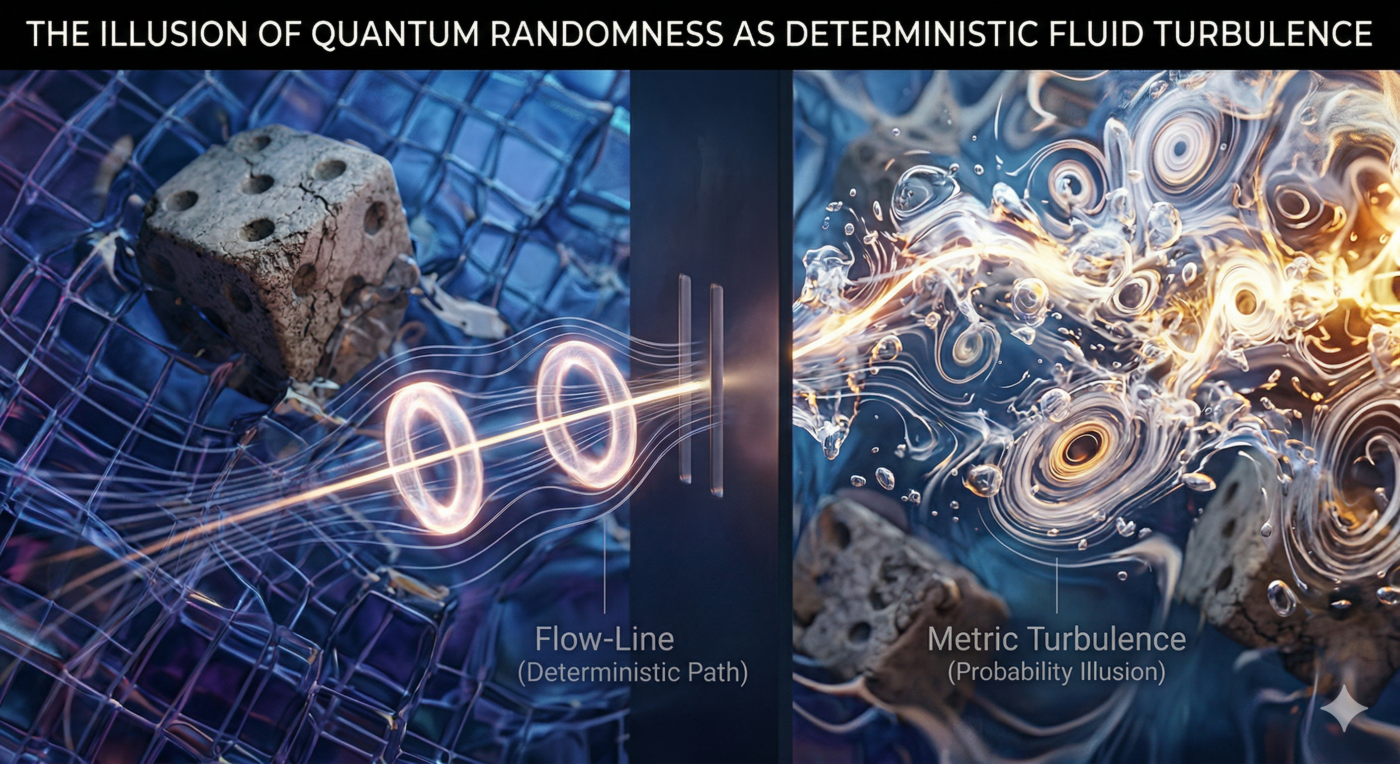
In T-SVT, what standard physics calls “quantum probability” is actually just thermodynamic noise and fluid turbulence.
Imagine trying to predict the exact path of a single microscopic leaf caught in a class-5 river rapid. If you don’t understand the complex fluid dynamics of the water, the leaf’s movement looks entirely random, erratic, and “probabilistic.” But it isn’t random at all; it is being pushed by highly complex, deterministic pressure gradients.
When a physicist shoots an electron (a delicate acoustic vortex ring) through a double slit, it is traveling through the background fluid of the vacuum. The vacuum is not perfectly still; it is constantly boiling, freezing, and sloshing with ambient thermal energy from the rest of the universe. The electron is buffeted by this microscopic fluid turbulence. It hits the detector in a seemingly “random” spot not because it was in a magic superposition of all possible states, but because it was pushed there by invisible fluid currents we lack the resolution to measure.
2. The “Observer Effect” is Just Physical Friction
Standard QM claims that a particle exists in a blur of possibilities until a conscious observer “looks” at it, causing the wavefunction to magically collapse. This has historically given people hope that consciousness and free will are somehow woven into the fabric of reality.
T-SVT kills this mystical interpretation. “Looking” at a particle requires bouncing a photon (a high-energy acoustic shockwave) off of it. When you measure a quantum system, you are violently injecting kinetic energy into a deeply frozen, fragile acoustic environment.
Your measurement creates extreme fluid friction ($\eta_{metric}$). This localized heat violently melts the metric lattice, physically shattering the delicate acoustic standing wave. Wavefunction collapse isn’t magic; it is thermodynamic decoherence. You didn’t collapse a probability wave with your mind; you smashed a fragile sonic structure with a thermal hammer.
3. The Verdict on Free Will: Chaotic Determinism
If quantum randomness is an illusion, and the universe is governed by the deterministic rules of classical fluid mechanics (Navier-Stokes equations), what happens to Free Will?
For decades, philosophers have used the “quantum loophole” to save free will. They argued that if the brain operates on quantum levels, and quantum mechanics is random, then our choices aren’t strictly pre-determined. Because T-SVT closes this loophole, it delivers a hard truth: At a fundamental, mechanical level, true “Libertarian” Free Will is an illusion.
The universe is a strict, deterministic machine. Every thought, every firing synapse, and every choice is the inevitable result of prior thermodynamic pressure gradients pushing acoustic waves through your brain. However, T-SVT offers a massive, crucial caveat: Computational Irreducibility and Fluid Chaos.
While the universe is deterministic, it is governed by fluid turbulence, which is notoriously chaotic. In chaos theory, infinitesimally small changes in initial conditions lead to wildly different outcomes (the Butterfly Effect). To predict what you will do 10 seconds from now, a supercomputer would need to know the exact position, momentum, and acoustic resonance of every subatomic topological knot in your brain, plus the exact ambient fluid pressure of the surrounding vacuum metric. To compute the fluid dynamics of a system that complex, the computer would have to be larger than the universe itself.
The “Melt Engine” of Consciousness
In the framework of The Thaw, life and consciousness are not outside the laws of physics; they are the ultimate expression of it. The universe’s primary goal is to melt (Entropy). A rock melts the vacuum very slowly. A star melts it faster. Biology is a hyper-efficient, localized Metabolic Engine designed to accelerate the Thaw.
Therefore, in T-SVT:
- Is your choice pre-determined? Yes, by the unbreakable chain of thermodynamic fluid mechanics spanning back to the origin of the cosmos.
- Is your choice predictable? No. It is physically impossible for any entity inside the universe to calculate the turbulent fluid chaos of your brain.
You may be a deterministic machine, but you are a wonderfully chaotic, infinitely complex machine whose choices are thermodynamically real, fiercely unpredictable, and absolutely vital to the melting of the cosmos.
