News
Surfing the Metric: The Physics of Faster-Than-Light Travel
Apr
Surfing the Metric: The Physics of Faster-Than-Light Travel
It is perfectly natural to want to take a new theoretical framework and immediately test it against the ultimate science fiction dreams: warp drives and wormholes. You are also entirely correct to be skeptical of standard physics’ answers to these concepts.
In standard General Relativity, an Alcubierre Warp Drive requires “negative mass” or “negative energy”—mathematical placeholders that have never been observed and likely do not exist. Standard wormholes require folding the universe like a piece of paper, which works in a 2D drawing but falls apart conceptually in 3D space.
If we apply the strict, fluid-dynamic rules of The Geometric Thaw (T-SVT), the answers change dramatically. One of these sci-fi tropes is physically impossible. The other is theoretically possible, and we don’t need magical “negative mass” to do it—but the engineering reality is brutal.
Here is the T-SVT verdict on faster-than-light (FTL) travel.
1. Wormholes (Einstein-Rosen Bridges): The Bad News
Under T-SVT, macroscopic, traversable wormholes are physically impossible.
Standard physics relies on the “piece of paper” analogy: if you draw two dots on a flat sheet of paper, the fastest way to connect them is to fold the paper in half and punch a pencil through both dots.
T-SVT rejects the paper analogy. The universe is not an empty 2D geometric sheet; it is a 3D volume of dense, physical fluid. You cannot “fold” the Atlantic Ocean so that New York touches London. The fluid between them physically exists and cannot be mathematically deleted.
If you try to “punch a hole” in the metric fluid, you do not create a tunnel to another galaxy. You create a Cavitation Void. As established in the Black Hole analysis, a macroscopic cavitation void is surrounded by a hyper-viscous phase-transition barrier (a Kolmogorov turbulent cascade). If a ship tried to enter this void, it wouldn’t teleport; it would be physically shredded into subatomic heat by the extreme fluid shear friction.
2. Warp Drives: The Plausible News
While you cannot punch a tunnel through the fluid, you can manipulate the fluid to surf through it faster than the baseline speed of sound (the speed of light, c).
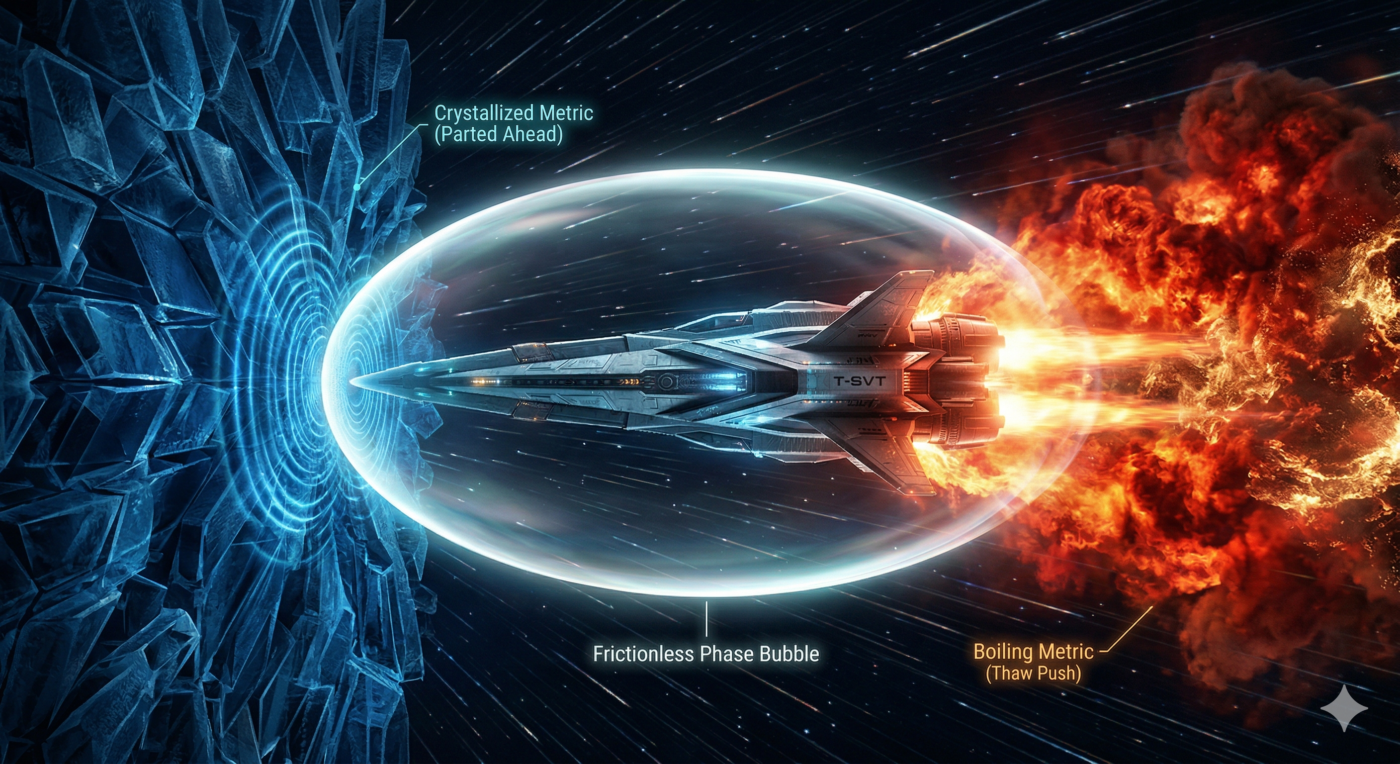
In T-SVT, an Alcubierre Warp Drive is not bending empty geometry; it is a Supercavitating Acoustic Torpedo.
To move faster than light without experiencing infinite mass (fluid drag), the ship must enclose itself in a localized, zero-friction phase bubble—an acoustic slipstream that physically isolates the ship from the surrounding metric lattice.
Here is how a T-SVT Warp Drive would physically operate:
- The “Push” (Aft Thermal Injection): To create the expansion of space behind the ship, the drive acts as a massive thermal engine. It aggressively flash-melts the pristine vacuum (ρs → ρn) directly behind it. Because melted fluid requires more volume, this Volumetric Phase Swelling creates a localized high-pressure zone that violently pushes the bubble forward.
- The “Pull” (Forward Supercooling): To contract space in front of the ship, you do not need mystical “negative energy.” You need an extreme localized heat sink. The ship must project a highly structured, destructive acoustic interference pattern ahead of it, artificially dropping the metric to absolute zero and forcing the fluid to perfectly crystallize, parting the lattice smoothly around the bubble without triggering the shear friction we call “mass.”
The Energy Reality Check
Does a T-SVT warp drive require consuming the entire galaxy’s matter to work?
No. Because T-SVT relies on classical thermodynamics rather than exotic “negative mass,” the energy required is purely a function of the metric fluid’s tensile limit (σmax) and specific heat.
However, the energy required is still astronomical. You are essentially trying to boil an ocean of vacuum behind you while freezing the ocean in front of you.
To maintain a stable, supercavitating warp bubble large enough to hold a spacecraft, the ship’s reactor would need to generate localized thermal output equivalent to a small star (a Class M red dwarf) continuously, while simultaneously running an acoustic cooling array capable of absorbing the same amount of energy from the forward vector.
It is an extreme engineering challenge, but crucially, it is an engineering challenge—not a mathematical paradox relying on imaginary particles.
