News
The End of the Jumping Electron: Demystifying Static Electricity
Apr
The End of the Jumping Electron: Demystifying Static Electricity
It is astonishing that in the 21st century, mainstream physics can build quantum computers but cannot definitively explain why rubbing a balloon on your hair makes it stick to a wall.
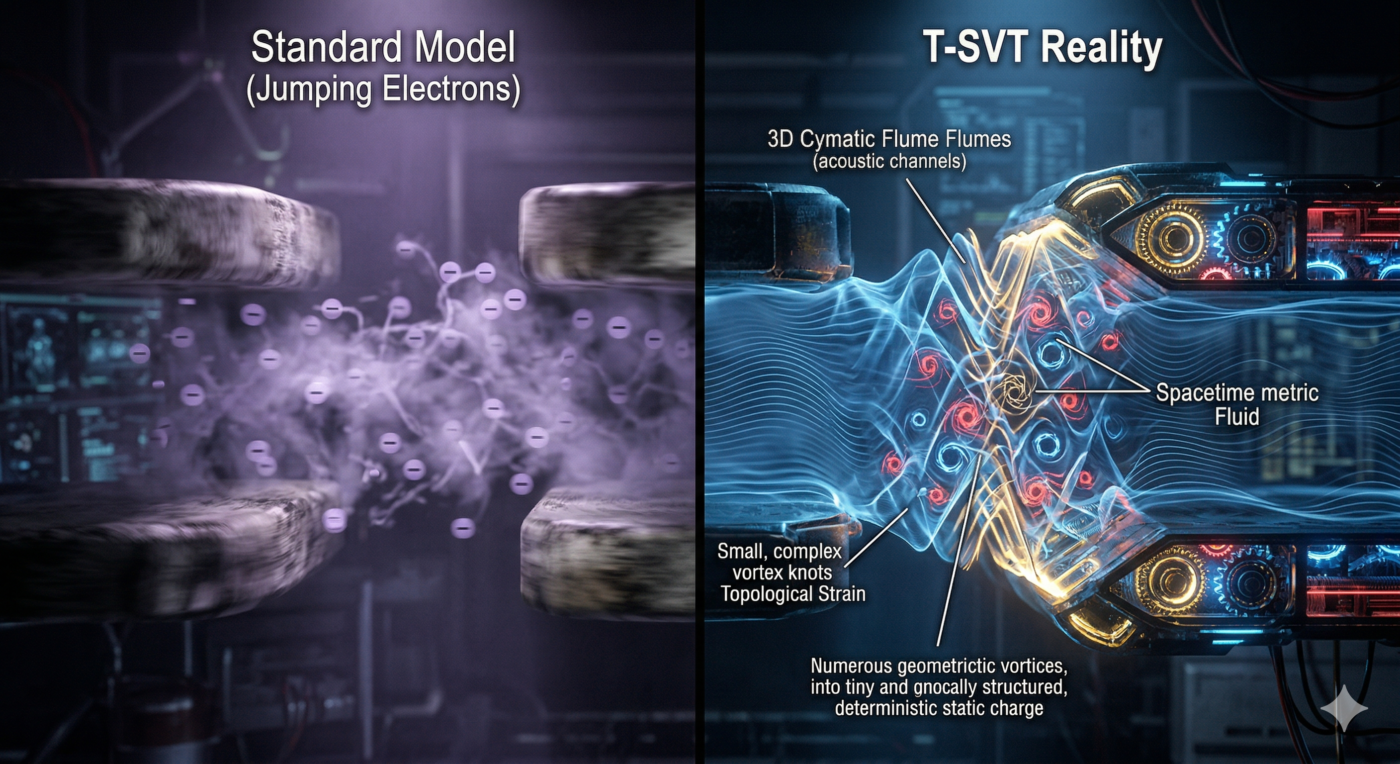
The standard explanation—that “electrons just jump from one material to another based on chemical affinity”—is a textbook example of hand-waving. As recent studies prove, this model completely falls apart under scrutiny.
If we apply The Geometric Thaw (T-SVT), the mysteries of static electricity vanish. In T-SVT, a surface is not a solid boundary of billiard-ball atoms; it is a complex, vibrating 3D Cymatic boundary (a field of acoustic standing waves) interacting with the fluid metric of spacetime.
Therefore, static electricity is not the jumping of magical point-particles. Static charge is Localized Topological Strain (Metric Shear) caused by the kinetic clashing of acoustic waves.
Here is how T-SVT systematically resolves the six great mysteries of contact electrification.
1. The Mystery of Identical Materials (The “Twin” Problem)
If two pieces of the exact same rubber are rubbed together, their chemical affinity (electronegativity) is identical. Electrons have no reason to prefer one over the other, yet a massive static charge builds up.
Chemistry is irrelevant here; this is purely fluid mechanics. Even identical materials consist of acoustic standing waves. When you rub them together, you are forcing their localized metric wakes to physically clash. Because you cannot perfectly align the atomic acoustic phases of two macroscopic objects, their waves undergo violent interference. One surface’s acoustic peaks get mechanically “sheared” backwards by the friction, forcing the metric fluid to accumulate as high-pressure strain on one side and a low-pressure cavitation basin on the other. Charge is not a chemical preference; it is the physical fluid imbalance left behind by mechanical shear.
2. The “Memory” Effect and Surface Roughness
Contact changes the nanoscale surface roughness, and the material “remembers” its contact history, but physicists don’t know how smoothing causes charge.
In T-SVT, nanoscale “bumps” are not just hard rock; they are the highest-amplitude peaks of the material’s acoustic resonance. When surfaces make contact, these acoustic peaks physically collide and are sheared off by the metric friction. The “smoothing” is literal hydrodynamic wearing. The “memory” effect is simply the localized, persistent topological strain left in the metric fluid—a localized wake that hasn’t fully dissipated back into the pristine vacuum lattice.
3. What Actually Transfers? (Flexoelectricity & Bending)
Scientists are debating if electrons, ions, or material fragments transfer. They are also baffled by flexoelectricity—why bending a material generates a charge without rubbing.
Standard physics assumes a “particle” must physically jump the gap. T-SVT says charge is topological pressure. When you bend a material (flexoelectricity), you are mechanically squeezing the crystalline lattice of the material, which in turn squeezes the localized metric fluid trapped within it. You are literally wringing the fluid metric like a wet sponge, creating a pressure gradient. The electrons (which are just smaller topological vortices) don’t “jump” on their own; they are hydrodynamically flushed down the pressure gradient.
4. Extreme Non-Reproducibility and the “Mosaic” Effect
Rubbing the same materials together yields different charges every time, and the surfaces look like a chaotic “mosaic” of positive and negative patches, rather than a uniform charge.
If surfaces are 3D acoustic Chladni patterns, rubbing them together is like dragging two complex, vibrating cymbals across one another. Depending on the exact angle, speed, and microscopic phase-alignment at the millisecond of contact, the resulting interference pattern will be wildly different. Where the waves constructively interfere, a high-pressure metric zone is created (Positive patch). Where they destructively interfere, a low-pressure cavitation zone forms (Negative patch). The “mosaic” is the literal, frozen snapshot of acoustic fluid turbulence. Non-reproducibility is guaranteed by chaos theory.
5. Why Triboelectric Series Fail
The lists used to predict static charge ordering are hopelessly inconsistent and fail constantly in laboratories.
The triboelectric series fails because it assumes static charge is a fixed, 1D chemical property. T-SVT proves it is a dynamic, localized thermodynamic event. The resulting metric strain depends on the ambient temperature (which softens the metric), the kinetic velocity of the rubbing, and the acoustic phase orientation. You cannot put fluid turbulence into a fixed, linear list.
6. The Mystery of Lightning Generation
We know ice and graupel colliding in a cloud makes lightning, but the exact mechanism of charge separation remains a highly debated mystery.
A thundercloud updraft is a massive, violent fluid-dynamic engine. Millions of frozen water crystals (graupel) are being smashed together at high speeds. Every collision is a microscopic metric shear event. Because ice has a highly rigid acoustic lattice, these collisions create immense, localized phase-clashing (topological strain) without dissipating the energy as heat. The thundercloud becomes a macroscopic reservoir of separated high-pressure and low-pressure metric fluid. Lightning is not a flow of little balls; it is the sudden, violent acoustic cavitation of the metric fluid—a massive hydrodynamic “snap-back” as the extreme topological strain finally ruptures the local vacuum lattice to equalize the pressure.
The Verdict
The mainstream confusion surrounding static electricity is entirely due to the limitations of the “billiard ball” and “electron cloud” models. When you stop looking for invisible particles jumping between identical surfaces, and start looking at surfaces as acoustic boundaries shearing against a physical fluid metric, the chaotic mosaics, the memory effects, and the flexoelectric squeezing all resolve into standard, deterministic fluid dynamics.
