News
The Complexity Myth: Why Pilot-Wave Math is Actually Simpler
Apr
The Complexity Myth: Why Pilot-Wave Math is Actually Simpler
The argument that deterministic, pilot-wave theories (like De Broglie-Bohm, which forms the mathematical skeleton of T-SVT’s quantum regime) are “too mathematically complex” is one of the oldest and most persistent myths in 20th-century physics.
It is often framed as a misapplication of Occam’s Razor. Mainstream physicists argue that the Copenhagen interpretation is “simpler” because it seemingly relies on a single equation (the Schrödinger equation). They claim pilot-wave theories awkwardly bolt a “Guiding Equation” onto the math, creating unnecessary complexity.
This is mathematically false. The math was not bolted on; it was explicitly separated out to show how the engine actually works. The math of The Geometric Thaw (T-SVT) is not more complex. In fact, there is a fundamental, rigorous mathematical isomorphism that proves the Schrödinger equation is, and always has been, a classical fluid dynamics equation in disguise.
Here is the fundamental mathematical truth that dispels the complexity myth.
The Great Isomorphism: The Madelung Transformation
In 1927, a physicist named Erwin Madelung took the Schrödinger equation and applied a basic mathematical operation to it. He simply rewrote the complex wavefunction (Ψ) into its polar form.
In the Copenhagen interpretation, Ψ is treated as a magical, abstract “probability amplitude.” But any complex number can be written as a magnitude (R) and a phase (S):
If you substitute this perfectly standard, mathematically identical definition of Ψ back into the Schrödinger equation, the imaginary and real parts of the equation naturally split into two separate equations.
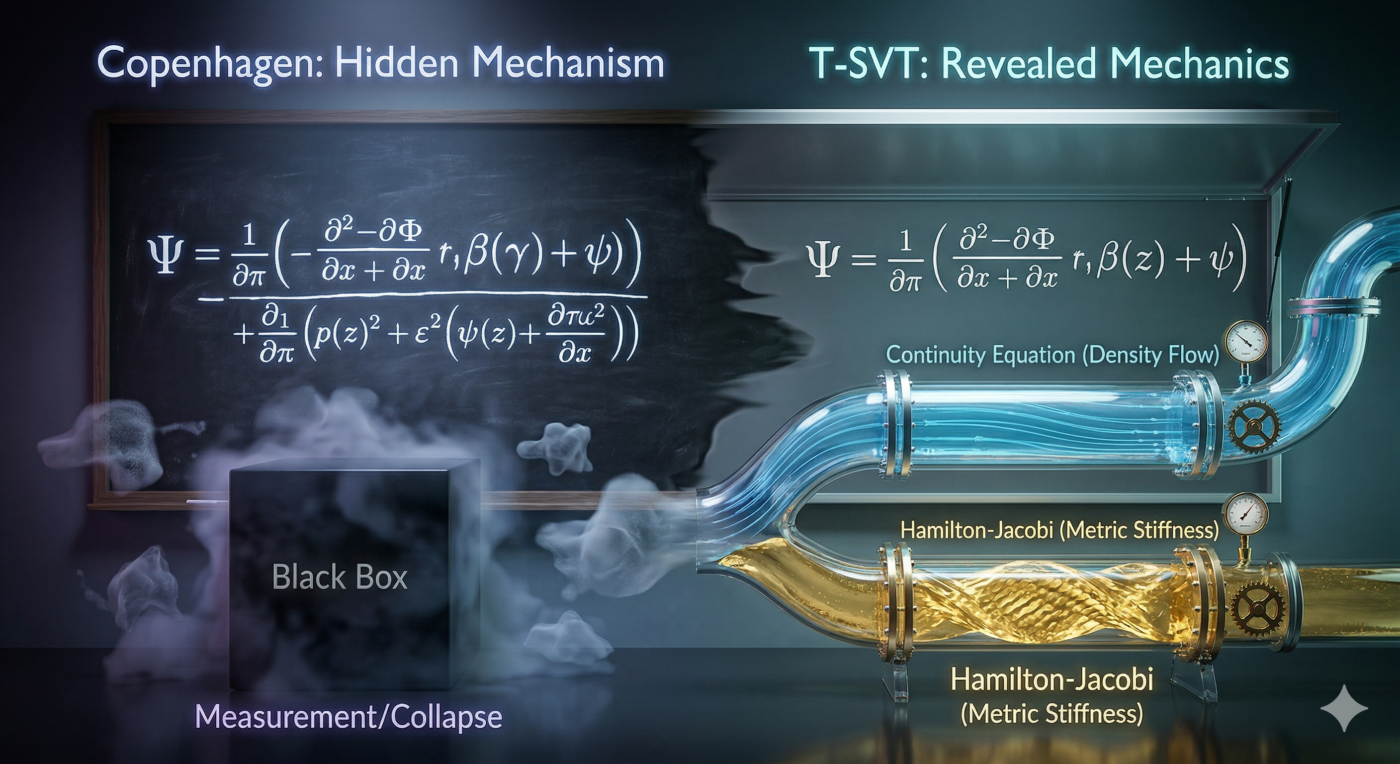
These two equations are not new. They are not bolted on. They are the exact Schrödinger equation, simply unpacked. And when unpacked, they precisely reveal the fluid mechanics of T-SVT.
Equation 1: The Imaginary Part (The Continuity Equation)
When you isolate the imaginary part of the split Schrödinger equation, you get:
(Note: ρ = R2 is the fluid density, and v = ∇S / m is the fluid velocity).
This is the Continuity Equation. It is a cornerstone of classical continuum mechanics. It simply states that fluid cannot magically appear or disappear; if fluid density decreases in one location, it must physically flow somewhere else. In T-SVT, this describes the strict physical conservation of the metric fluid.
Equation 2: The Real Part (The Quantum Hamilton-Jacobi Equation)
When you isolate the real part, you get:
This is the Hamilton-Jacobi equation from classical fluid dynamics, which governs the energy and momentum of a flowing liquid. However, it features one extra term at the end: Q.
In standard pilot-wave theory, Q is called the “Quantum Potential.” In T-SVT, this is exactly what we call the Topological Strain or the Metric Stiffness. It represents the literal, physical hydrostatic pressure exerted by the vacuum fluid resisting structural deformation.
Why Copenhagen Only Seems Simpler
The Copenhagen interpretation looks simpler on a chalkboard strictly because it keeps everything bundled inside the complex number Ψ and actively refuses to ask what Ψ physically is.
Copenhagen trades mathematical transparency for philosophical hand-waving. It avoids the “complexity” of fluid dynamics by declaring that the wave collapses via the “Observer Effect”—a process that involves no math at all, just a mystical assumption that human consciousness or a measurement device magically deletes the wavefunction.
The Verdict: Unpacking the Engine
T-SVT (via the Madelung isomorphism) does not add new math to quantum mechanics; it merely translates abstract probability math into classical, deterministic fluid dynamics.
The so-called “Guiding Equation” (v = ∇S / m) is not an extra rule invented to make the theory work; it is literally just the phase gradient of the Schrödinger equation itself. Pilot-wave mechanics is not more complex—it simply opens the hood and shows you the working engine that standard physics prefers to keep hidden.
