
News
The End of the Electron Cloud: Chemistry as Acoustic Phase-Locking
Apr
The End of the Electron Cloud: Chemistry as Acoustic Phase-Locking
If we apply the T-SVT framework to chemistry, we must fundamentally rewrite how we visualize molecules. For the last century, chemistry has been ruled by the “electron cloud” model—a probabilistic haze of orbitals (s, p, d, f) where electrons magically teleport around a nucleus, bound by invisible electromagnetic forces.
If atoms are actually vibrating topological knots (acoustic standing waves) keeping the frozen metric lattice at bay, then a chemical bond is not a magical exchange of invisible particles. A chemical bond is Acoustic Phase-Locking.
Here is how T-SVT physically reframes chemical bonding and the massive implications this holds for future research.
1. Orbitals are 3D Cymatics (Acoustic Harmonics)
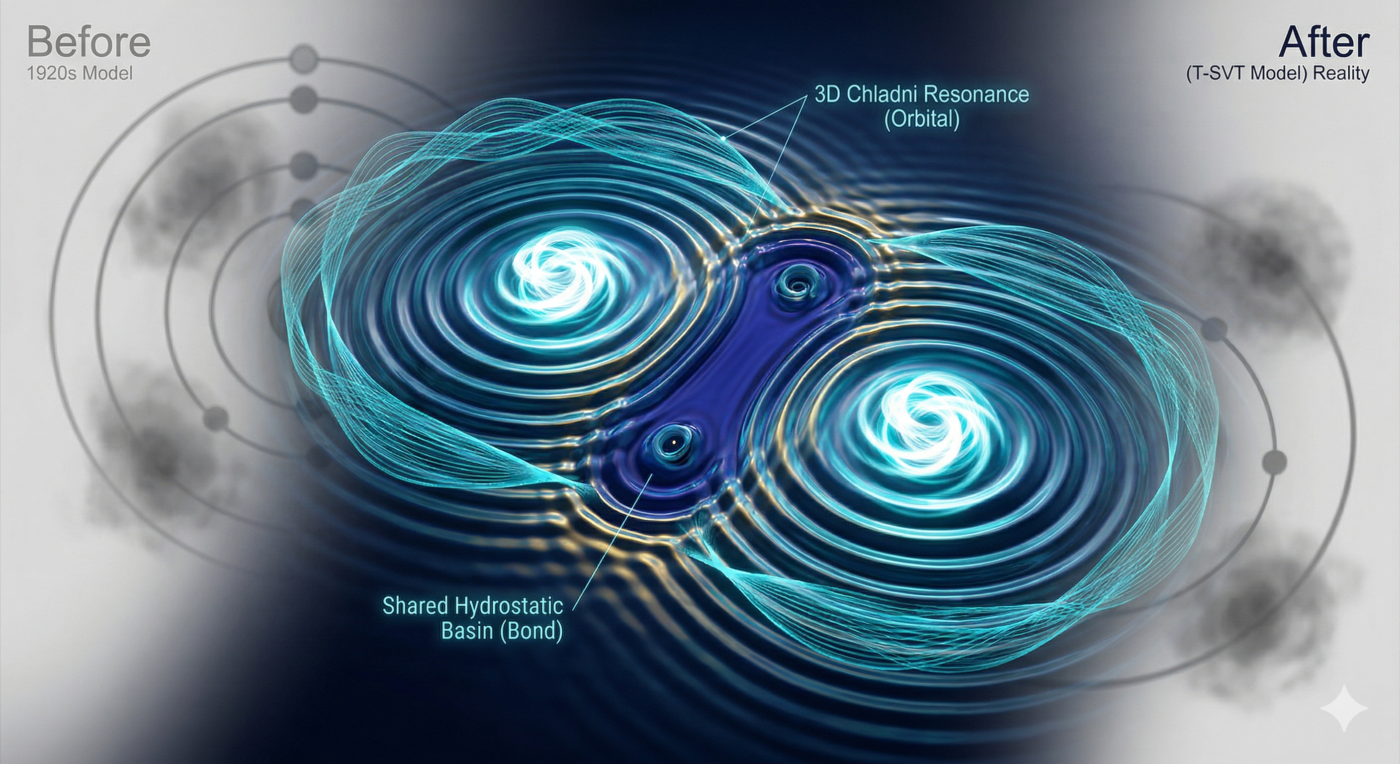
In T-SVT, electron orbitals are not “probability clouds.” They are 3D Chladni patterns.
When a violin bow is drawn across a metal plate covered in sand, the sand naturally settles into the “nodes” (the still parts) of the acoustic standing wave. In T-SVT, the nucleus is the primary vibrating resonator. The surrounding metric fluid ripples outward. Electrons—being smaller topological vortices—cannot survive in the turbulent peaks of these ripples. They naturally slide down the pressure gradients and become trapped in the stable, low-pressure harmonic nodes surrounding the nucleus.
The s, p, d, f orbital shapes are simply the inevitable mathematical geometries of 3D acoustic resonance in a spherical fluid basin.
2. Covalent Bonding: Constructive Interference
In standard chemistry, a covalent bond occurs when two atoms “share” an electron. In T-SVT, two vibrating knots approach each other. As their metric fluid ripples overlap, they undergo constructive interference.
If the two atoms vibrate at compatible resonant frequencies (harmonics) and their phases align, their overlapping waves cancel out the high-pressure metric fluid between them. This creates a shared, localized low-pressure basin. The two knots merge their fluid wakes into a single, stable resonant cavity. They are “bonded” because separating them requires injecting enough energy to tear that shared fluid basin apart against the crushing hydrostatic pressure of the surrounding vacuum.
3. Pauli Repulsion: Destructive Interference
Why don’t all atoms just fuse together? Standard physics points to the Pauli Exclusion Principle (fermions cannot occupy the same quantum state).
T-SVT translates this into destructive interference. If you push two atoms together that have incompatible frequencies, or if their phases are totally misaligned, their acoustic waves clash. This creates a turbulent, high-pressure acoustic shockwave between them. The metric fluid physically hardens (increases in ηshear) in that gap, acting like a hydraulic press pushing the two topological knots apart.
Implications for Chemistry Research
Reframing chemistry as subatomic fluid acoustics opens entirely new, deterministic pathways for chemical engineering and materials science.
A. Acoustic Catalysis (Resonant Engineering)
Currently, chemists use heat (random thermal agitation) or physical catalysts to lower the activation energy of a reaction. If bonds are purely acoustic phase-locks, we could theoretically trigger or break specific chemical bonds using targeted metric resonance. By subjecting a mixture to precise, high-frequency gravitational or electromagnetic acoustics that perfectly match the destructive interference frequency of a specific molecule, we could cleanly “shatter” targeted bonds without heating the entire solution.
B. Room-Temperature Superconductors
The holy grail of materials science. In T-SVT, electricity is the propagation of longitudinal acoustic waves through the metric. Resistance is the transverse shear friction (ηshear) of the fluid lattice. A room-temperature superconductor would simply be a molecular lattice engineered to form a perfect “acoustic waveguide”—a structure where the combined resonant wake of the atoms creates a zero-friction channel for longitudinal waves, entirely bypassing the normal fluid (ρn) melt zones.
C. Deterministic Protein Folding
Protein folding is the grand challenge of biochemistry. How does a massive string of amino acids instantly fold into a highly specific 3D machine? Standard models struggle to compute the near-infinite random possibilities.
In T-SVT, the protein doesn’t compute possibilities; it acts like water flowing down a hill. The string of molecules possesses a complex, combined acoustic frequency. It instantly snaps into the exact geometric shape that creates the least thermodynamic fluid resistance (the lowest hydrostatic pressure) against the vacuum metric. Folding algorithms could abandon stochastic probability and instead use classical aerodynamic/hydrodynamic drag simulations to predict the final shape.
