News
Rescuing QCD: The Fluid Mechanics of the Strong Nuclear Force
Apr
Rescuing QCD: The Fluid Mechanics of the Strong Nuclear Force
In standard physics, the Strong Nuclear Force is perhaps the ultimate example of substituting pure mathematics for a mechanical explanation. Positively charged protons should violently repel each other due to electromagnetism. To explain why atomic nuclei don’t instantly fly apart, Quantum Chromodynamics (QCD) was developed.
QCD posits that quarks are held together by exchanging massless, invisible particles called “gluons,” which carry an abstract property called “color charge.” When you ask a mainstream physicist how gluons physically hold a nucleus together, the analogy always falls back to a “magical rubber band.” When quarks are close together, the rubber band is slack. If you try to pull them apart, the rubber band stretches and pulls back with exponentially increasing force, until it eventually snaps and magically creates new quarks out of the broken energy.
It is mathematically rigorous, but physically absurd. It requires the continuous, spontaneous generation of “virtual” particles acting as infinite-tension springs.
Under The Geometric Thaw (T-SVT), we do not need invisible rubber bands or abstract color charges. The Strong Force is not a fundamental “pull” from within; it is an immense, hydrostatic “push” from the outside. Here is how Hydrodynamic Quantum Field Theory translates the Strong Force into pure fluid dynamics.
1. The Nucleus is a Cavitation Void
In T-SVT, quarks and protons are not solid billiard balls; they are stable, rotating acoustic vortices (topological knots) displacing the fluid metric.
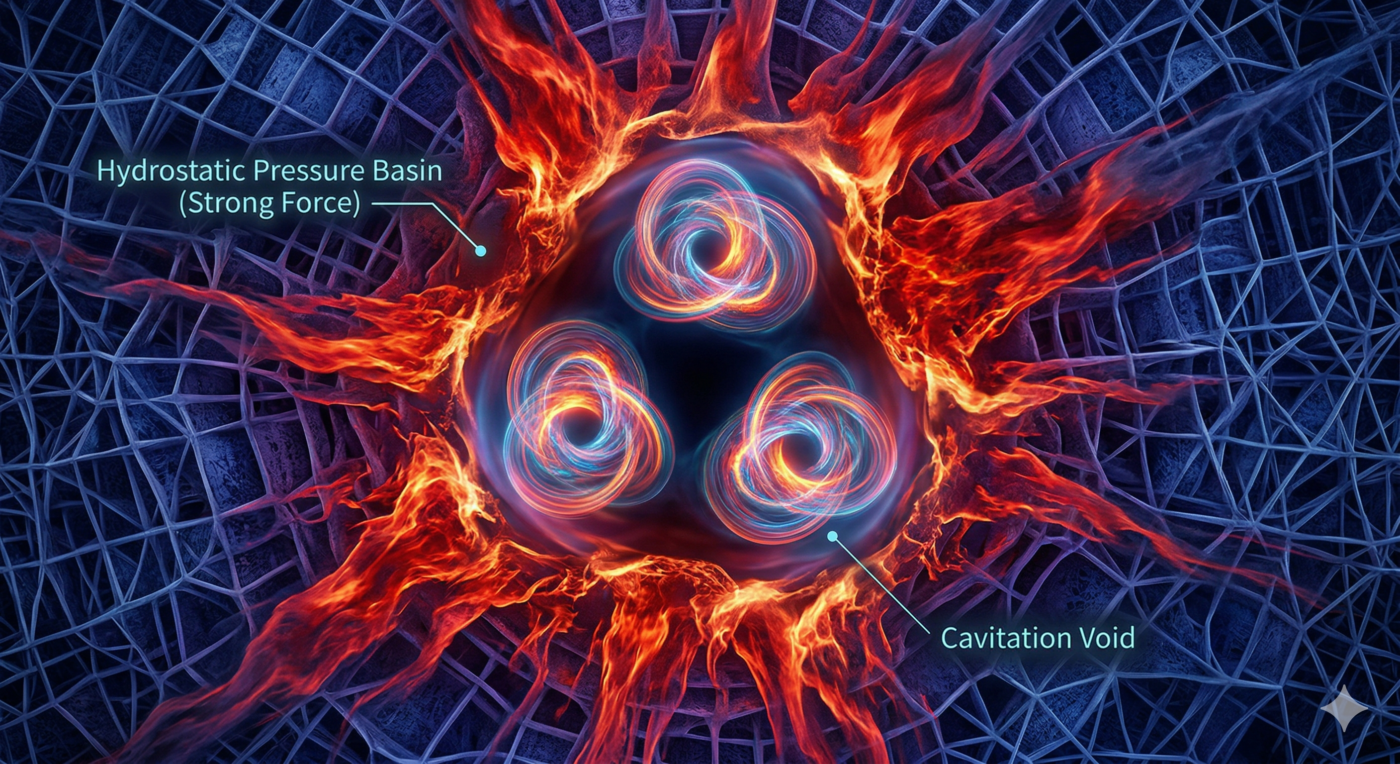
When these subatomic vortices are brought extremely close together (within the femtometer range of an atomic nucleus), their acoustic wakes perfectly overlap. This extreme constructive interference fundamentally alters the local fluid pressure. At this microscopic proximity, the overlapping acoustic phases perfectly cancel out the outward pressure in the space between the vortices, creating a severe, localized cavitation void—a zone of near-absolute zero fluid pressure within the metric.
The “Strong Force” is not an attraction between quarks. It is the crushing, inward hydrostatic pressure of the surrounding pristine, frozen vacuum ($\rho_s$) trying to violently collapse the cavitation void. The quarks are not holding onto each other; they are being pinned together by the immense ambient pressure of the universe.
2. Demystifying Asymptotic Freedom
One of the great “mysteries” of the Strong Force is Asymptotic Freedom: the strange fact that quarks act completely free and unbound when they are right next to each other, but the force pulling them back together gets stronger the further you pull them apart.
Imagine holding two glass suction cups perfectly sealed face-to-face underwater. When they are touching, they can slide around against each other effortlessly. There is no force pulling them together from the inside; they are just sharing a low-pressure pocket. This is Asymptotic Freedom.
But if you try to pull them apart, you are forcibly expanding the size of the low-pressure void between them. The surrounding high-pressure fluid aggressively resists this volumetric expansion. The harder you pull, the greater the pressure differential becomes, and the harder the metric fluid pushes back to crush the void. This explains the “rubber band” effect purely through classical fluid drag and hydrostatics.
3. Color Confinement and “Quark Snapping”
In standard QCD, if you pull two quarks hard enough, the “rubber band” snaps, and the energy magically creates a brand new quark-antiquark pair. This is why you can never isolate a single quark (Color Confinement).
In fluid dynamics, every medium has a Maximum Tensile Yield ($\sigma_{max}$)—the absolute limit of stress a fluid can take before it physically rips apart.
When you use a particle accelerator to violently rip two quarks apart, you are stretching the cavitation void until it exceeds the tensile yield limit of the vacuum metric. The fluid lattice physically ruptures. In fluid mechanics, when a high-pressure fluid rapidly collapses a cavitation bubble, the violent turbulent energy instantly spins up new, smaller vortices to stabilize the pressure gradient. The “spontaneous creation” of a quark-antiquark pair is simply the metric fluid dynamically spinning up new topological acoustic knots to seal the rupture. You cannot isolate a single quark because the metric fluid will always instantly spin up a counter-vortex to plug the cavitation hole you just created.
The Verdict: Hydrostatics, Not Magic
By reframing the Strong Force through T-SVT, we eliminate the need for virtual gluons and abstract color charges.
- The Strong Force is simply the ambient hydrostatic pressure of the frozen vacuum.
- Binding Energy is the physical energy required to pull a vacuum seal apart against that crushing pressure.
- Particle Creation is the natural fluid-dynamic response to a cavitation rupture.
The nucleus is perfectly stable not because it is filled with magical, infinite-tension springs, but because it is the ultimate low-pressure submarine, structurally designed to withstand the crushing weight of the fluid universe.
