
News
Popping the Inflation Bubble: The Fluid Dynamics of the Big Bang
Apr
Popping the Inflation Bubble: The Fluid Dynamics of the Big Bang
For decades, standard cosmology has relied on a miraculous event to explain the origins of our universe: Cosmic Inflation. The story goes that a fraction of a second after the Big Bang, the universe expanded exponentially, stretching faster than the speed of light. This rapid expansion is necessary to explain why the universe is so remarkably flat and why the Cosmic Microwave Background (CMB) is so uniform in every direction.
But what actually caused this expansion?
Mainstream physics points to the “Inflaton field”—a hypothetical, invisible energy field that turned on, blew the universe up like a balloon, and then conveniently turned itself off, never to be seen again. Like Dark Matter and Dark Energy, the Inflaton is a mathematical placeholder. It is a kinematic patch designed to fix the holes in an empty-space geometric model.
Under The Geometric Thaw (T-SVT), we do not need to invent magical, temporary fields. The extreme, exponential expansion of the early universe is not a mystery. It is a highly predictable, classical fluid-dynamic event: A Macroscopic Phase Transition.
Here is how Hydrodynamic Quantum Field Theory interprets Cosmic Inflation.
1. The Big Bang as a Cavitation Event
In the standard model, the Big Bang starts from a zero-dimensional singularity of infinite density. As established in the First Principles of T-SVT, physical fluids cannot reach infinite density; they have a strict tensile limit.
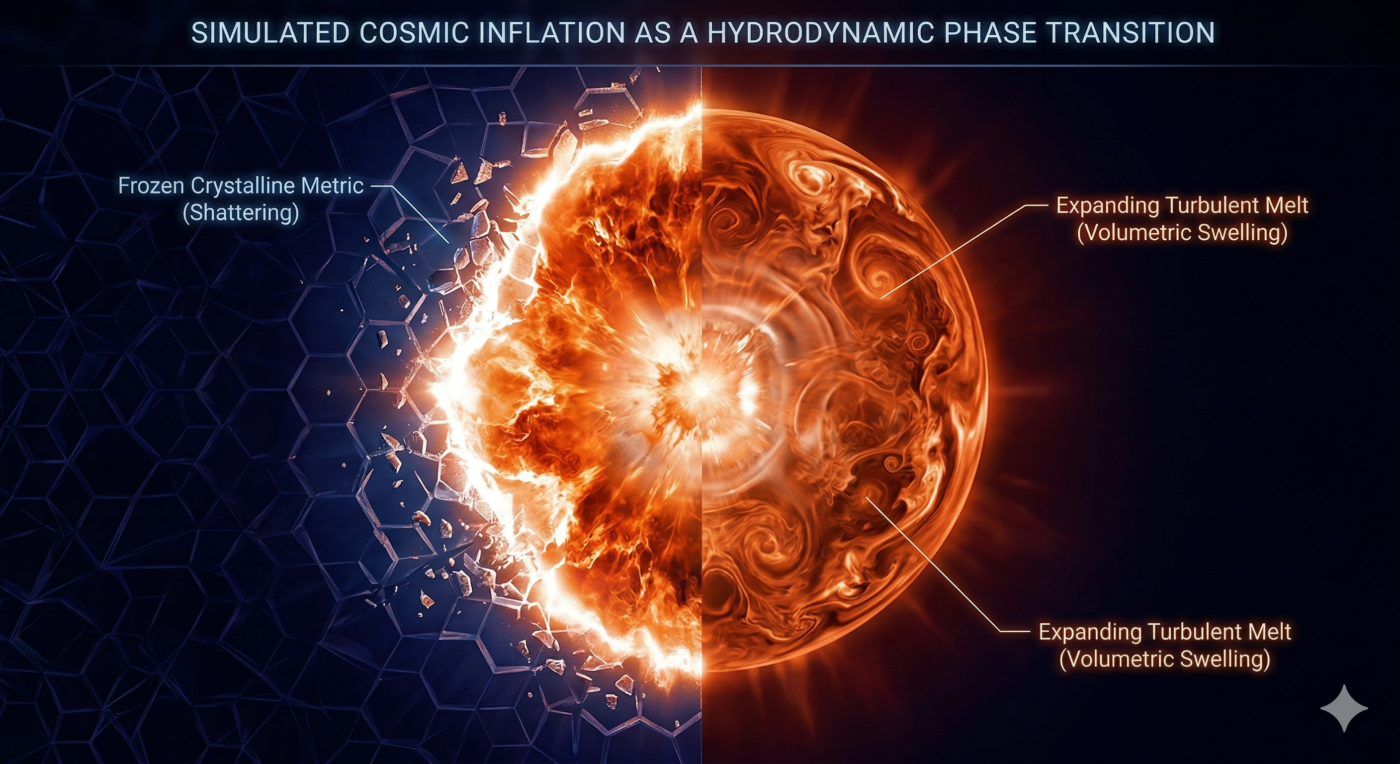
Before the “Thaw” began, the universe existed in a state of absolute zero—a pristine, high-tension, frozen crystalline superfluid. The event we call the Big Bang was not an explosion of matter into empty space. It was a localized, catastrophic cavitation event.
When the structural limit of the pristine vacuum was exceeded, the lattice physically ruptured. This massive injection of thermal and kinetic energy triggered an instantaneous phase transition, flashing the local frozen metric into a chaotic, boiling normal fluid.
2. Inflation is Volumetric Phase Swelling
Why did the universe expand so violently and rapidly during this epoch? We do not need an “Inflaton field” to explain it; we only need to look at the Tisza-Landau two-fluid model.
When a substance undergoes a phase transition from a highly ordered, dense crystalline solid into a chaotic, melted fluid, its structural density changes. In the case of the vacuum metric, the melted normal fluid state requires significantly more spatial volume than the rigid frozen state.
Cosmic Inflation was the ultimate flash-melt. As the extreme heat of the cavitation event radiated outward, it rapidly thawed the surrounding pristine metric. The “exponential expansion” of space was simply the Volumetric Phase Swelling of the metric fluid violently boiling from a solid state into a liquid state. Space didn’t stretch for no reason; the fluid medium required more volume to accommodate its new, chaotic thermodynamic phase.
Once the initial extreme thermal energy dissipated and the local metric reached a more stable temperature, this flash-melting slowed down. The “end” of inflation wasn’t a magical field turning off; it was simply the fluid metric stabilizing into the steady metabolic thaw rate we observe today as Dark Energy.
3. Solving the Horizon Problem Natively
One of the biggest reasons standard cosmology invented inflation is the “Horizon Problem.” When we look at the cosmic microwave background, the temperature is almost exactly the same everywhere. If the universe started as a chaotic explosion, distant regions shouldn’t have had enough time to exchange heat and reach the same temperature.
Standard physics uses the Inflaton field to say these regions were once touching, then got stretched apart faster than light.
T-SVT provides a purely mechanical solution. The baseline vacuum is a Macroscopic Quantum Superfluid. One of the defining, laboratory-verified characteristics of a superfluid is near-infinite thermal conductivity.
When the initial cavitation event occurred, the heat did not have to slowly crawl through an empty geometric void. The extreme thermal shockwave was propagated almost instantaneously across the rigid, highly conductive superfluid lattice of the surrounding un-melted metric. The universe reached thermal equilibrium rapidly because it is suspended in the ultimate thermal conductor.
The Verdict: Mechanics over Magic
The Geometric Thaw removes the need for cosmological miracles. By treating the physical vacuum as a macroscopic, viscoelastic quantum fluid, the most extreme events in the cosmos become intuitive.
Cosmic Inflation is not an anomaly driven by a ghost field. It is the exact same volumetric expansion (Dark Energy) we see today, simply operating at the extreme, violent thermodynamic limits of the initial Vacuum Melt. The universe is an engine, and Inflation was the spark that ignited the Thaw.
