The Glossary of the Thaw
The Rosetta Stone of Physics. Translating the mathematical abstractions of the Standard Model into the mechanical reality of Continuum Fluid Dynamics.
I. Macro Cosmology
Dark Matter
An invisible, weakly interacting ghost particle that makes up 27% of the universe, holding galaxies together.
Viscoelastic Spacetime Creep. Not a particle, but the structural memory and topological tension of the vacuum fluid resisting the rotation of a galaxy.
Dark Energy
A mysterious, unexplainable force driving the accelerated expansion of the universe, making up 68% of reality.
Volumetric Phase Swelling. The latent heat exhaust from stars melting the frozen, pristine superfluid vacuum. As it thaws into a normal fluid, it requires more physical volume, physically pushing the cosmos apart.
Gravity (Space-Time Curvature)
The bending of an empty, four-dimensional geometric fabric, possibly mediated by an undetectable “graviton” particle.
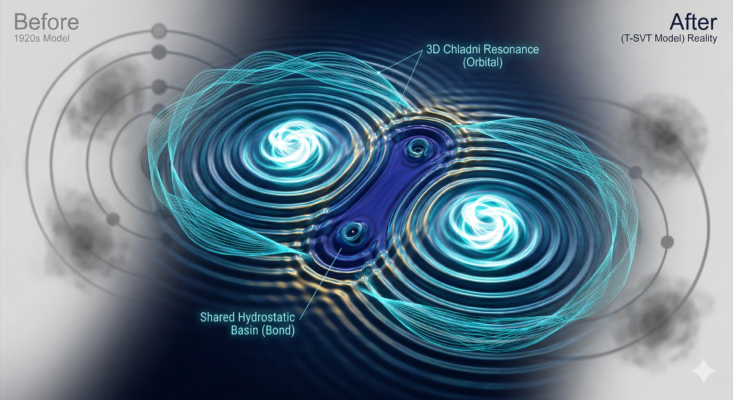
Hydrostatic Pressure Basins. Massive bodies act as thermodynamic engines that melt the vacuum around them. This creates a viscous “melt basin” with an inward-flowing pressure gradient. Gravity is classical fluid pressure.
Fermi Bubbles
Unexplained massive lobes of radiation emitting from the poles of the Milky Way, likely historical echoes of magnetic jets.
Thermodynamic Exhaust Vents. The central black hole cavitates the fluid. Due to the high viscous drag of the spinning galactic equator, the boiling metric takes the path of least resistance, venting heat vertically into the deep vacuum.
II. Quantum Mechanics & QED
Virtual Particles
Ghostly particles that pop in and out of existence to carry forces between electrons.
Acoustic Pressure Gradients. A mathematical abstraction of classical acoustic shear and pressure waves traveling through the superfluid metric between two stable nodes.
Antimatter
Regular matter traveling backwards in time, which mysteriously converts entirely to energy when touching normal matter.
Acoustic Phase Inversion. An inverted standing wave (a hydrodynamic sink instead of a source). Annihilation is simply perfect destructive acoustic interference, radiating the lost structure away as massless transverse shear waves (gamma rays).
Renormalization
A mathematical trick used to manually subtract infinities out of the equations to prevent the theory from breaking.
Granular Tensile Limits. Infinities don’t exist. The mathematical “cut-off” is the literal, physical breaking point of the metric lattice—the point where the fluid cavitates or reaches its acoustic wavelength limit.
The Arrow of Time
A 4th geometric dimension that strictly moves forward due to mathematical entropy, though equations allow backward travel.
The Irreversible Phase Transition. Time is not a dimension. It is the macroscopic, thermodynamic sequence of the pristine superfluid permanently melting into a viscous fluid. You cannot un-melt the cosmos.
III. The Nucleus (QCD & Weak Force)
Quarks & Color Charge
Point-particles with fractional charges that must combine in three “colors” (Red, Green, Blue) to exist.
Fractional Topological Defects. Acoustic nodes that cannot complete a full 360-degree phase rotation alone. Three must phase-lock across the x, y, and z axes (colors) to form a stable, whole integer standing wave (a proton).
Gluons & Color Confinement
Force-carriers that permanently glue quarks together. Pulling them apart magically creates new quarks to replace the broken bond.
Superfluid Flux Tubes & Elastic Fracture. Gluons are non-linear shear waves traveling along taut fluid tension lines. Confinement is classical mechanics: if you stretch the fluid past its tensile limit, it snaps, creating two new topological ends.
W & Z Bosons (Weak Force)
Incredibly heavy force-carrier particles that somehow dictate radioactive decay over ridiculously short ranges.
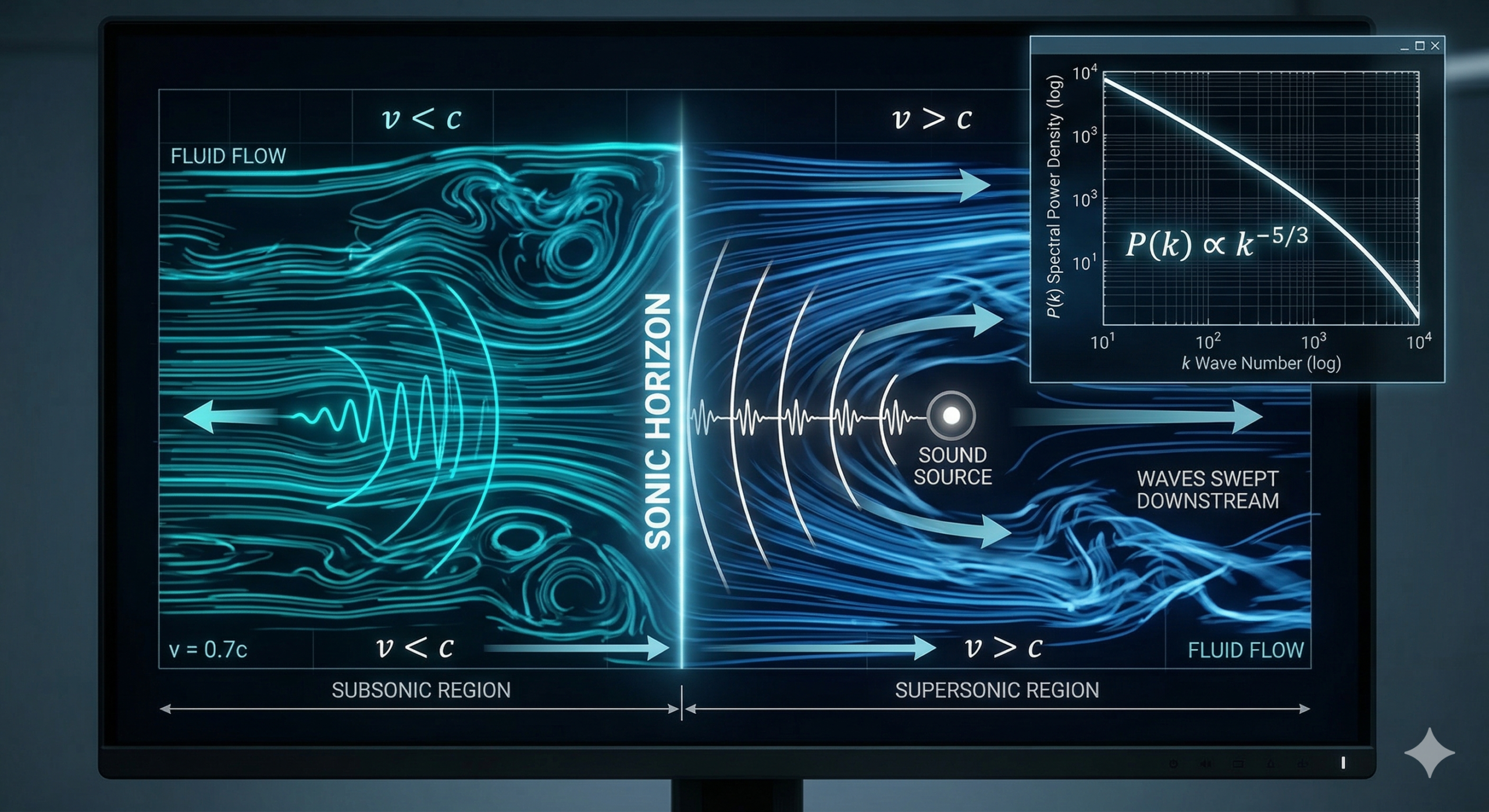
Highly Damped Shockwaves. Unlike frictionless photons, these are longitudinal shockwaves that interact violently with the stiff 246 GeV lattice. The surrounding fluid immediately dampens and absorbs their kinetic energy, restricting their range.
Radioactive (Beta) Decay
A neutron randomly changes a quark “flavor” to become a proton, ejecting an electron and a neutrino from the vacuum.
Topological Phase-Slip. A hydrodynamically unstable acoustic knot (the neutron) geometrically snaps into a more aerodynamic, lower-drag configuration (the proton), shedding its excess structural tension as acoustic exhaust (the electron).
IV. Constants & Anomalies
The Fine-Structure Constant (1/137)
A mysterious, unitless “magic number” that acts as a free parameter dictating the probability of an electron emitting a photon.
Acoustic Impedance Mismatch. The exact thermodynamic coupling efficiency (ratio) between a transverse shear wave (photon) and a longitudinal compression wave (electron) interacting within the metric fluid.
The Hierarchy Problem
The mathematical crisis of the 17 orders of magnitude difference between the Planck scale and the Higgs (Electroweak) scale.
Granularity vs. Acoustics. The Planck scale is the discrete atomic hardware of the fluid. The Higgs scale is the macroscopic acoustic wave traveling through it. It is the exact difference between splitting a water molecule and creating an ocean wave.
Homochirality (Biological Handedness)
The fact that all biological DNA twists right and all amino acids twist left is a random chemical accident from early Earth.
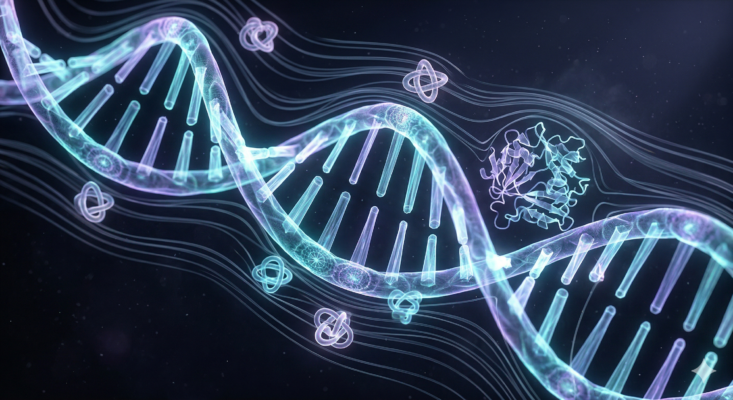
Hydrodynamic Selection. The quantum vacuum has a native, microscopic chiral “twist” (parity violation). Biology simply streamlined its biomolecules to match the current of the spacetime fluid to minimize viscoelastic drag and save metabolic energy.
The Mass of the Electron
An arbitrary constant (0.511 MeV) derived from an unexplainable “Yukawa coupling” to the Higgs field.
The Viscoelastic Drag Coefficient. The baseline fluid friction generated by the lowest-energy fundamental harmonic standing wave pushing through the 246 GeV metric lattice.