News
Rescuing QED with The Geometric Thaw
Apr
Rescuing QED: Fluid Dynamics vs. Feynman’s Ghosts
Richard Feynman was arguably the greatest intuitive physicist of the 20th century. His development of Quantum Electrodynamics (QED) gave humanity the most precisely tested mathematical model in history. It is the crown jewel of the Standard Model.
However, Feynman was famously dissatisfied with his own masterpiece. He knew that to make his math work, he had to employ tricks that defied physical reality. He referred to the mathematical accounting holding QED together—specifically renormalization—in terms that would shock a modern physics student.
“It’s a dippy process… I suspect that renormalization is not mathematically legitimate. It is what I would call a hocus-pocus process, sweeping infinity under the rug.”
Feynman suspected that his math was merely an approximation of a deeper, mechanical reality that the physics community was ignoring. He was right. QED is only incomprehensibly complex because it treats the vacuum as an empty, geometric void.
Under the Geometric Thaw (Thermodynamic Superfluid Vacuum Theory, or T-SVT), we validate Feynman’s deepest suspicions. We keep his brilliant mathematical accounting, but we replace his “magic” with continuum fluid mechanics. When you translate QED onto the hardware of a macroscopic quantum fluid, the infinities disappear, and the magic vanishes.
Here is how the Geometric Thaw rescues QED from the dark.
1. The Myth of “Virtual Particles”
To explain how two electrons repel each other without touching across an empty void, Feynman proposed that they constantly toss invisible, undetectable “virtual photons” back and forth. Standard physics asks us to believe the vacuum is a boiling sea of ghostly particles popping in and out of existence to mediate forces.
The Fluid Translation: Acoustic Pressure Gradients
There are no ghost particles in T-SVT. The vacuum is a physical, 246 GeV macroscopic quantum fluid. An electron is a specific acoustic standing wave that acts as a localized fluid pressure “sink.” When two electrons approach each other, they aren’t throwing invisible tennis balls. Their localized pressure gradients physically interact through the intervening fluid. Two sinks in close proximity create a region of extreme negative acoustic pressure, causing the surrounding higher-pressure fluid to mechanically push them apart. Virtual particles are just a mathematical abstraction of classical acoustic shear and pressure waves traveling through the superfluid metric.
2. Decoding Feynman Diagrams
Feynman diagrams are the iconic stick-figure drawings used to calculate subatomic interactions. In the standard view, these lines represent literal point-particles traveling through an empty void, crashing into each other at magical mathematical vertices where one particle turns into another.
The Fluid Translation: Hydrodynamic Flow Charts
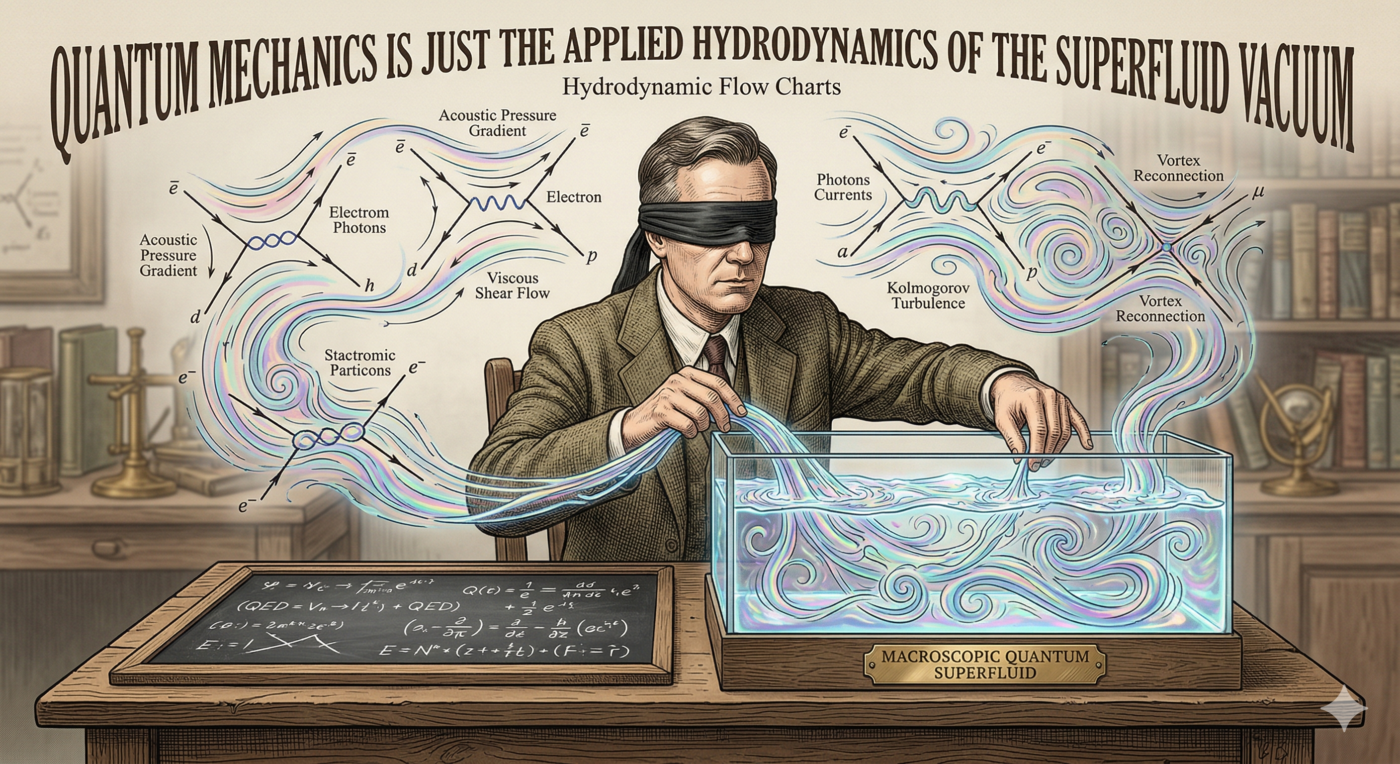
In a fluid universe, particles are not points; they are complex topological knots (solitons) in the metric. Therefore, a Feynman diagram is not a map of colliding billiard balls—it is a literal hydrodynamic flow chart. The lines represent stable acoustic currents and quantized vortices within the superfluid. The vertices (where lines meet) are literal hydrodynamic junctions, exactly like two rivers merging or a whirlpool splitting. The math of Feynman diagrams works so perfectly because it is accidentally mapping the conservation of fluid momentum and vorticity.
3. The Path Integral (Sum Over Histories)
To calculate the probability of a particle moving from Point A to Point B, Feynman’s Path Integral states that the particle mathematically takes every possible path through the universe simultaneously. These infinite paths then interfere with each other to determine the final route.
The Fluid Translation: The Acoustic Pilot Wave
A single particle does not magically split into infinite copies and travel to Jupiter and back to cross a laboratory room. Under T-SVT, the particle strictly follows deterministic, De Broglie-Bohm hydrodynamics. The standing wave takes one, single, physical path. However, as it moves, it displaces the background superfluid, projecting a vast, radial Acoustic Pilot Wave outward in all directions. This Pilot Wave does physically explore every possible path in the room, bouncing off walls and slits. The reflected acoustic waves crash back into the central particle, guiding its physical trajectory. Feynman’s “Sum Over Histories” is simply a brilliant approximation of global acoustic back-reaction in a fluid.
4. Renormalization: Solving the Infinities
If you calculate the self-energy of an electron using QED, the answer is infinity, which breaks the theory. To fix this, physicists invented “renormalization”—artificially cutting off the equations at a certain point and subtracting the infinities by hand. This was the “hocus-pocus” that Feynman hated, knowing it meant the theory was structurally flawed.
The Fluid Translation: Granular Tensile Limits
Infinities only exist in QED because the theory treats the electron as a zero-dimensional point (requiring infinite density) and the vacuum as a continuous void. In the Geometric Thaw, there are no infinities. The vacuum is a physical fluid with a fundamental atomic granularity (the Planck scale lattice). An electron cannot be infinitely small; it has a minimum physical radius dictated by the acoustic wavelength limit of the fluid. Furthermore, the fluid has a maximum tensile strength. If energy gets too high, the fluid simply boils (cavitates). The “cut-off” that Feynman had to manually type into his equations is actually the literal, physical structural limit of the cosmic slushie.
Richard Feynman didn’t simplify the universe; he built the most accurate software emulator in history. But he was modeling a macroscopic quantum fluid blindfolded.
When you port Feynman’s math off the “empty void” emulator and onto the native hardware of a physical fluid, the magic vanishes.
It turns out Feynman wasn’t writing particle physics. He was writing continuum acoustics.
