News
Why Matter Vibrates: The Acoustic Survival of the Atom
Apr
Why Matter Vibrates: The Acoustic Survival of the Atom
There is a glaring physical discrepancy in standard 20th-century physics that has been hiding in plain sight for a hundred years. The fact that all matter vibrates—even at absolute zero—is not a “quantum quirk.” It is a massive, flashing neon sign pointing directly to fluid mechanics.
In standard physics, if you place a particle in an empty, geometric void and remove all kinetic and thermal energy, it should just sit perfectly still. But it doesn’t. Standard Quantum Mechanics observed this and invented Zero-Point Energy, mathematically justifying it via the Heisenberg Uncertainty Principle. They claim you simply “can’t know” its exact position, so it must “jitter.”
The Geometric Thaw (T-SVT) rejects this explanation. In a fluid universe, atomic vibration is not a probabilistic fluke; it is a matter of strict acoustic survival.
1. The Illusion of the “Resting” Particle
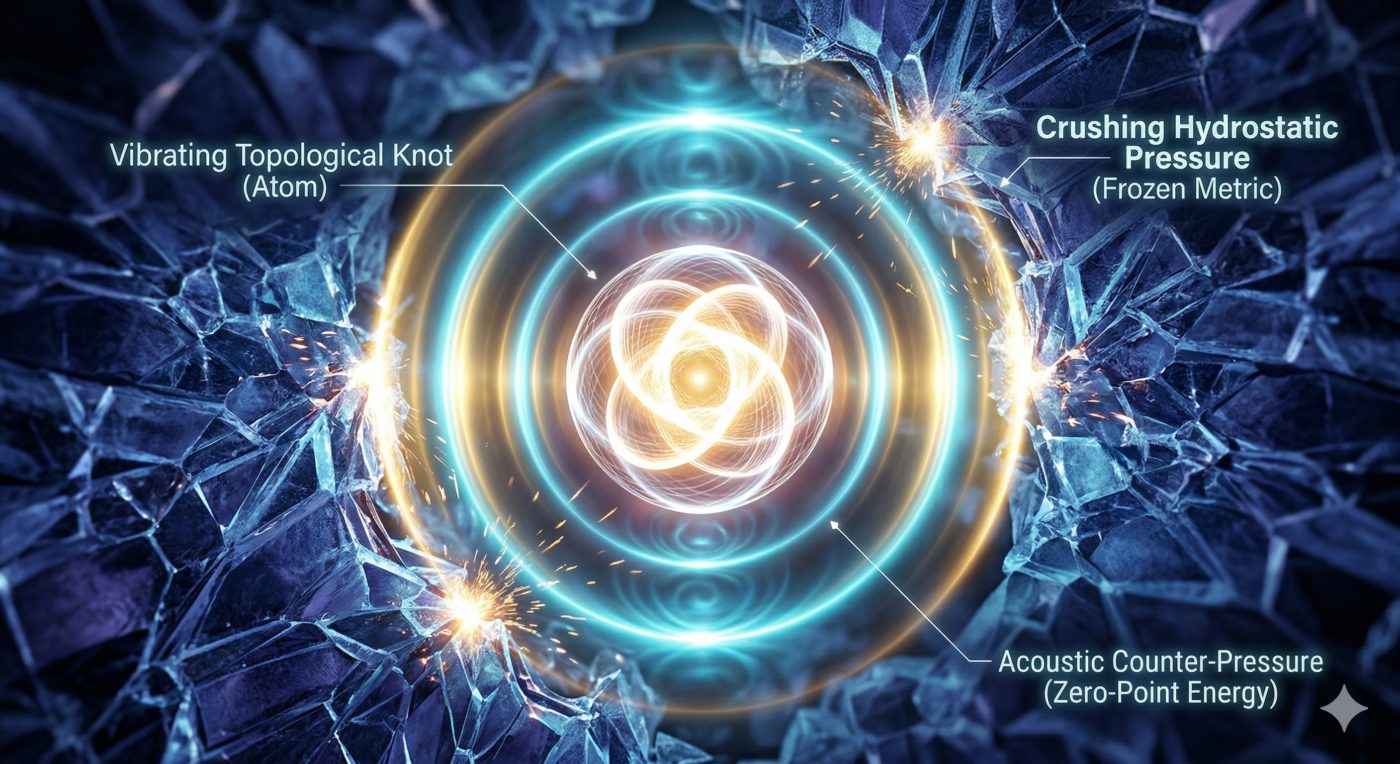
Under T-SVT, there is no such thing as a “solid” particle. An atom is a 3D topological defect—a closed acoustic standing wave (a vortex knot) spinning within the macroscopic quantum superfluid of the vacuum.
By definition, a wave cannot exist at rest. A wave is vibration. If a sound wave stops vibrating, it ceases to exist. Therefore, an atom vibrates because it is literally made of localized acoustic resonance. To stop vibrating is to vanish.
2. Zero-Point Energy as Acoustic Hydrostatic Balance
Why does matter vibrate even at absolute zero (0 K)?
In deep space, the baseline vacuum is a pristine, frozen crystalline superfluid (ρs). It exerts immense hydrostatic pressure. For a topological knot to maintain its structural integrity and avoid being crushed out of existence by the rigid metric lattice, it must exert an equal outward acoustic pressure.
The “Zero-Point Energy” vibration is simply the fundamental baseline resonant frequency required to push back against the vacuum’s maximum tensile yield (σmax):
The atom vibrates at absolute zero because it is “treading water” to keep the frozen ocean of the metric from collapsing its localized volume.
3. Thermal Vibration and “The Thaw”
When you heat a piece of iron, the atoms vibrate more violently, causing the metal to expand. Standard physics says the “billiard balls” are just bouncing around faster. T-SVT provides the actual fluid-dynamic mechanism.
When you inject thermal energy into an atom, it acts as a microscopic Metabolic Engine. The heat radiating from the atom locally melts the surrounding pristine metric (ρs → ρn).
- The Phase Shift: The rigid, high-pressure crystalline lattice surrounding the atom softens into a viscous, turbulent normal fluid.
- The Amplitude Shift: Because the localized hydrostatic pressure holding the atom together drops (due to the melt), the acoustic standing wave requires more volume to maintain equilibrium.
The “thermal vibration” increases in amplitude precisely because the surrounding fluid walls have become softer and more turbulent. This is exactly why matter expands when heated: it is the physical swelling of the local metric fluid between the atoms.
The Verdict: A Living Metric
Zero-Point Energy is not a mathematical ghost; it is the physical heartbeat of a universe under pressure. By treating the atom as an acoustic resonator in a fluid metric, the “spooky” jitter of quantum mechanics becomes a classical necessity of survival.
