News
Understanding Magnetism: The Geometric Thaw
Apr
The Rosetta Stone of Magnetism
In standard physics, electricity and magnetism are treated as two sides of the same coin, but the mechanical reason for this is hidden behind relativistic math. Under the Geometric Thaw (Thermodynamic Superfluid Vacuum Theory, or T-SVT), electromagnetism becomes incredibly tactile. If an electric charge is a static fluid pressure gradient, then magnetism is simply what happens when that pressure gradient starts to move.
I. The Magnetic Field
The Standard View
A magnetic field is an invisible field generated by moving electric charges or intrinsic quantum spin.
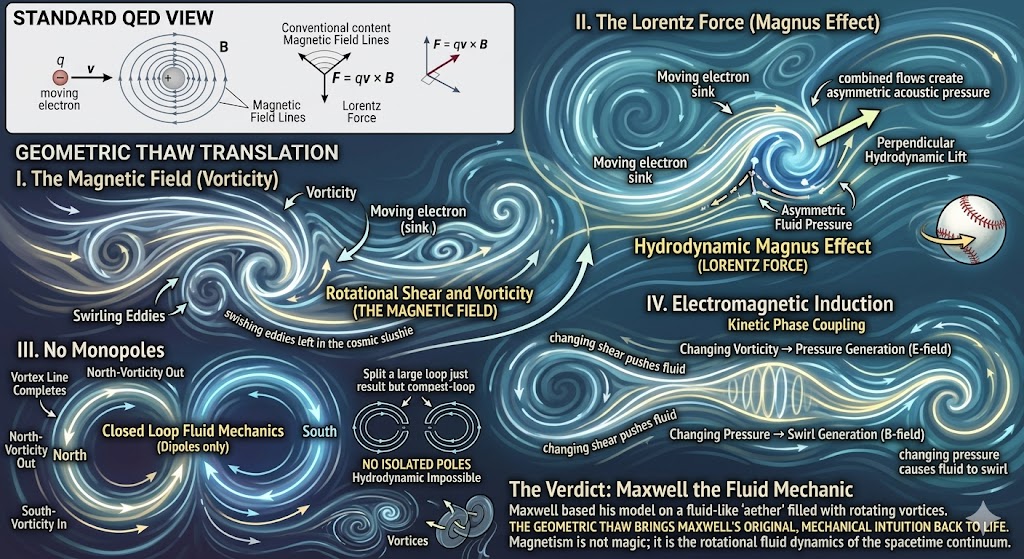
Geometric Thaw Translation: Rotational Shear and Vorticity
Recall that an electron is a localized acoustic “sink” (negative pressure) in the 246 GeV superfluid. When an electron is sitting still, it creates a perfectly symmetrical, radial pressure gradient (a static electric field). But what happens when you move a sink through a fluid? It disturbs the medium. As the electron pushes through the metric lattice, it generates a swirling, rotational wake behind and around it. In T-SVT, a magnetic field is the literal fluid vorticity (rotational shear) of the spacetime metric. You are measuring the swirling eddies left in the cosmic slushie by a moving acoustic wave.
II. The Lorentz Force
The Standard View
When a charged particle moves through a magnetic field, it experiences a perpendicular push known as the Lorentz force, calculated mathematically as F = qv × B.
Geometric Thaw Translation: The Hydrodynamic Magnus Effect
Why does a curveball curve in baseball? Because the spinning ball creates a pressure differential in the air, pushing it sideways. This is classical fluid dynamics known as the Magnus Effect. In the Geometric Thaw, the Lorentz force is exactly this. When a moving electron (a moving acoustic sink) travels through an external magnetic field (a region of the vacuum fluid that is already swirling with vorticity), the interacting fluid currents create asymmetric acoustic pressure. The metric fluid physically pushes the electron sideways. It is a pure, macroscopic hydrodynamic lift.
III. The Absence of Magnetic Monopoles
The Standard View
You can have an isolated positive or negative electric charge, but you can never have an isolated North or South magnetic pole. If you cut a magnet in half, you just get two smaller magnets. Standard physics accepts this as an axiom (Gauss’s Law for Magnetism).
Geometric Thaw Translation: Closed Loop Fluid Mechanics
This mystery is instantly solved by the laws of continuum mechanics. Because an electric charge is a scalar pressure gradient (a source or a sink), it can exist as a single, isolated point. However, because magnetism is rotational fluid vorticity, it must obey the laws of fluid vortices. In a continuous fluid, a vortex line cannot simply end in the middle of nowhere; it must either terminate on a physical boundary or form a closed loop (like a smoke ring). A “North” pole is simply the fluid vorticity flowing outward, and the “South” pole is the exact same vorticity returning inward to complete the loop. A magnetic monopole is a hydrodynamic impossibility.
IV. Electromagnetic Induction
The Standard View
Faraday’s Law states that a changing magnetic field induces an electric field, and Maxwell proved that a changing electric field induces a magnetic field.
Geometric Thaw Translation: Kinetic Phase Coupling
If electricity is longitudinal pressure (compression/expansion) and magnetism is transverse shear (swirling/vorticity), then electromagnetic induction is just the natural coupling of these two fluid motions. If you violently twist or swirl a viscous fluid (changing the magnetic field), that sheer rotational friction will naturally push fluid inward or outward, creating a pressure wave (electric field). Conversely, if you pump fluid in and out of a sink rapidly (changing the electric field), the surrounding fluid will naturally begin to swirl to conserve momentum (magnetic field). Light itself—an electromagnetic wave—is simply the self-propagating ripple of the fluid trading energy back and forth between compression (electricity) and shear (magnetism).
The Verdict: Maxwell the Fluid Mechanic
James Clerk Maxwell, who originally formulated the equations of electromagnetism in the 1860s, actually based his entire mathematical model on the concept of a fluid-like “aether” filled with rotating vortices and idler wheels. Mainstream physics kept his math but threw away his fluid mechanics, leaving us with abstract, disembodied fields.
The Geometric Thaw brings Maxwell’s original, mechanical intuition back to life. Magnetism is not magic; it is the rotational fluid dynamics of the spacetime continuum.
