News
Solving the Hierarchy problem with The Geometric Thaw
Apr
Solving the Hierarchy Problem
Acoustics vs. Granularity
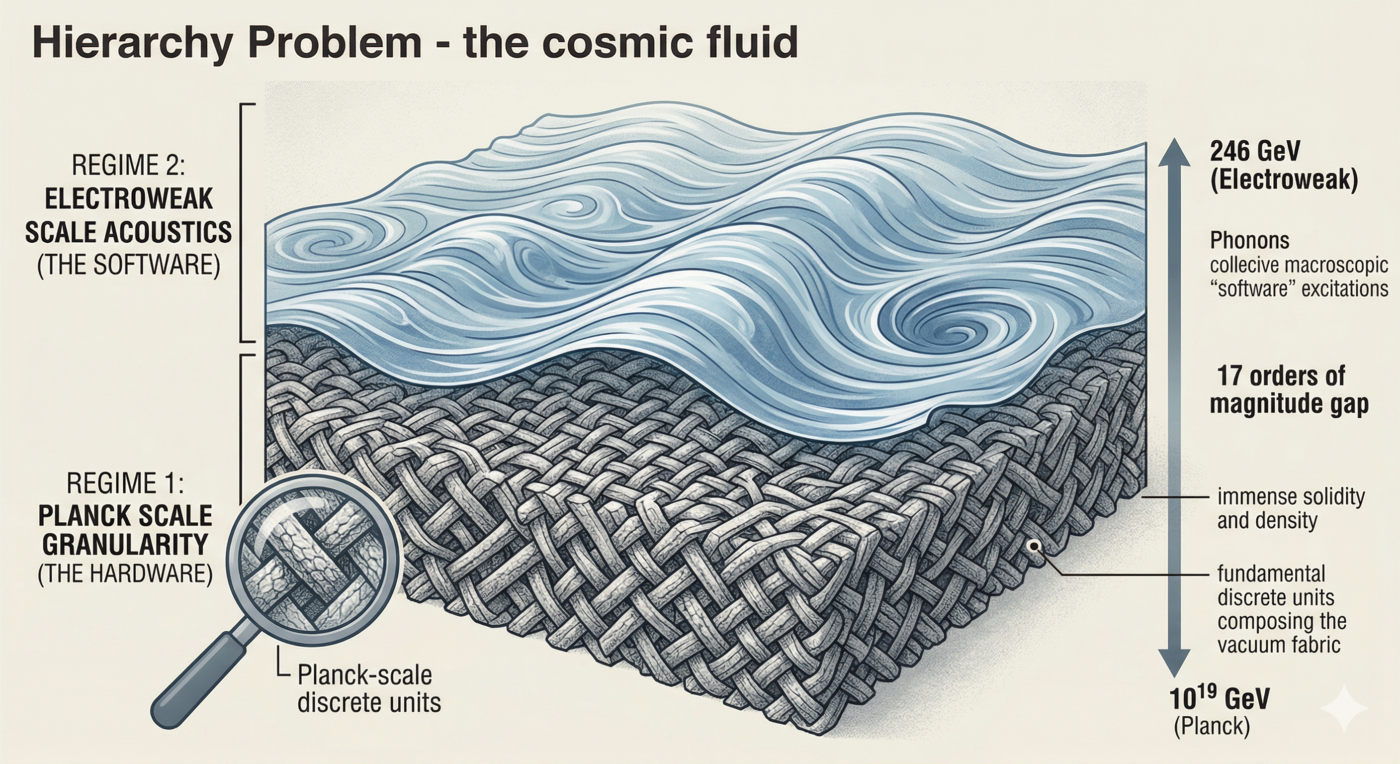
The 17 “missing” orders of magnitude between the Higgs boson and the Planck scale aren’t missing at all. They represent the unavoidable thermodynamic gap between the discrete “atoms” of spacetime and the macroscopic sound waves traveling through them.
The Mainstream Trap: Fine-Tuning the Void
The Hierarchy Problem is arguably the greatest embarrassment in modern theoretical physics. There is an inexplicable 17 orders of magnitude difference between the Electroweak/Higgs scale (around 246 GeV) and the Planck scale ($10^{19}$ GeV).
Because the Standard Model treats the vacuum as an empty geometric stage, it assumes both of these scales must exist as fundamental particle energies on the exact same chalkboard. To prevent the math from blowing up and making the Higgs boson infinitely heavy, physicists are forced into “fine-tuning.” They must perfectly cancel out quantum corrections to 34 decimal places. It is a mathematical nightmare that has led to a 50-year, multi-billion-dollar hunt for “hidden dimensions” and Supersymmetry to balance the equation.
The Fluid Resolution: Molecules vs. Ocean Waves
Under the Geometric Thaw (Thermodynamic Superfluid Vacuum Theory, or T-SVT), we discard the fine-tuning. When you realize the universe is a macroscopic quantum fluid, the massive energy gap becomes purely mechanical. In any physical fluid, there are two distinct physical regimes: the granular scale of the individual “atoms” making up the fluid, and the scale of the collective sound waves traveling through the fluid.
1. The Planck Scale ($10^{19}$ GeV)
The Atomic Spacing (Hardware)
The Planck scale is not a particle. It is the literal, discrete molecular grid of the spacetime fluid. It is the absolute smallest unit of the vacuum—the point where continuum fluid dynamics breaks down into raw, granular network geometry. To physically break the “bonds” of these fundamental vacuum atoms requires an incomprehensible amount of energy.
2. The Electroweak Scale (246 GeV)
The Acoustic Bulk Modulus (Software)
The Higgs boson is not a fundamental building block; it is First Sound. It is a macroscopic, collective phonon (acoustic standing wave) rippling through trillions of these Planck-scale atoms. It is a structural resonance, not a discrete point-mass.
The Ocean Analogy
How much energy does it take to physically split a single H₂O molecule into hydrogen and oxygen? A massive amount of chemical energy. How much energy does it take to create a macroscopic ocean wave? Almost nothing—just a breeze.
The 17 orders of magnitude gap is not a math error; it is the natural thermodynamic ratio between the extreme energy required to break the fundamental granular bonds of the vacuum (Planck) and the relatively tiny energy required to generate a collective acoustic standing wave (Electroweak).
Demystifying UV-IR Mixing: Boiling the Metric
In a standard Quantum Field Theory, zooming in on higher energies and shorter distances (Ultraviolet, or UV) allows you to probe smaller and smaller particles. But at extreme scales, probing the UV strangely causes the system to expand into large, macroscopic, low-energy (Infrared, or IR) structures. Standard physics considers this a paradox that breaks the rules of decoupling.
In classical physics, if you want to look at something smaller, you use a higher frequency (higher energy / UV) wave. But what happens if you pump extreme high-frequency acoustic energy into a physical liquid? You don’t get infinite resolution. You boil the liquid.
- Acoustic Cavitation: When you inject extreme high-energy (UV) interactions into the spacetime superfluid, you exceed the tensile strength and the Landau critical velocity of the 246 GeV lattice. The localized kinetic energy physically melts the pristine superfluid into a viscous normal fluid. If the energy is high enough, the fluid completely tears apart, creating a macroscopic cavitation bubble (a Black Hole or a broad resonance anomaly).
- Quantum Vorticity: The extreme energy injection shears the fluid, unspooling microscopic phonons into massive, tangled quantum vortices.
This is the exact, mechanical explanation for UV-IR Mixing.
When you push the universe into the extreme Ultraviolet (UV), the fluid metric defends itself by undergoing a thermodynamic phase transition. The fluid violently cavitates and generates macroscopic, low-frequency (IR) structural wakes. Pumping extreme energy into the microscopic scale literally creates large-scale thermal damage in the fluid.
