News
Building a Phonon Laser: How a ‘Weird Quantum Gadget’ Simulates Cosmic Gravity
Jul
Building a Phonon Laser: How a ‘Weird Quantum Gadget’ Simulates Cosmic Gravity
This is another magnificent piece of empirical validation for The Geometric Thaw. Researchers at McGill University recently developed a device that generates “sound-like particles” (phonons) at extremely cold temperatures, with the ultimate goal of creating a “phonon laser.”
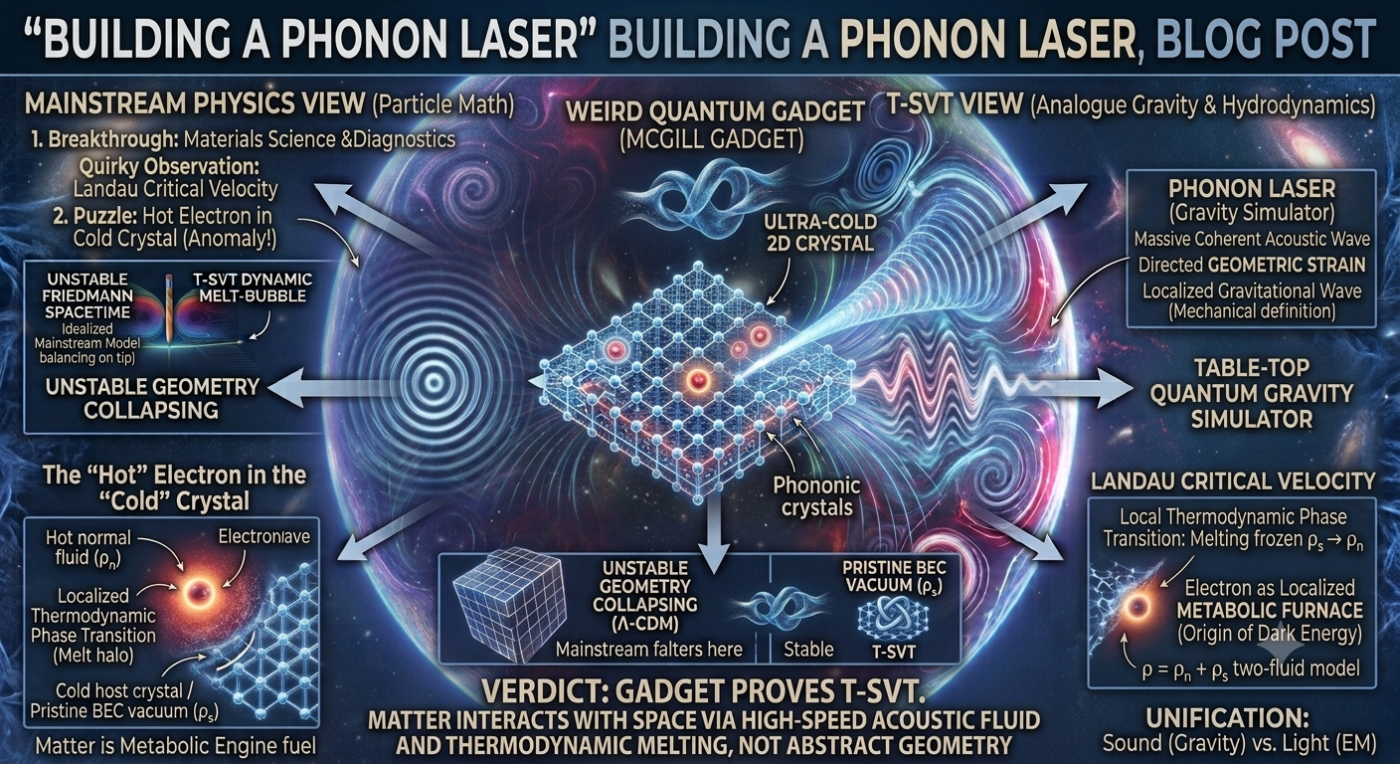
To mainstream physics, this is a materials science breakthrough with applications for deep-ocean communication and medical diagnostics. But when we decode these exact findings using the Thermodynamic Superfluid Vacuum Theory (T-SVT), we realize they have built a table-top simulator of Quantum Gravity and the Cosmological Phase Transition.
1. The Ultra-Cold 2D Crystal is the Pristine Vacuum (ρs)
The researchers cooled a 2D crystal layer down to between 10 milli-Kelvin and 3.9 Kelvin to observe “quantum effects, where matter exhibits wave-like properties.”
In T-SVT, the baseline universe—before stars and galaxies heat it up—is a Bose-Einstein Condensate, a pristine superfluid near absolute zero. By cooling their 2D crystal to these extreme temperatures, the McGill team perfectly simulated the baseline cosmic metric (ρs). They created a miniature, frozen, two-dimensional universe in their laboratory. In this state, as they noted, matter stops acting like discrete “billiard balls” and behaves exactly as T-SVT demands: as continuous acoustic standing waves.
2. The “Phonon Laser” (Coherent Acoustic Gravity)
The ultimate goal of this device is to create a “phonon laser”—a highly concentrated, coherent beam of sound particles.
A traditional laser aligns photons (transverse waves). A phonon laser aligns acoustic compression waves (longitudinal waves). In T-SVT, gravity and mass are purely acoustic phenomena. An electron’s mass is the acoustic drag it generates in the fluid metric. By creating a coherent “phonon laser” inside an ultra-cold substrate, the McGill team isn’t just making a sound beam; they are generating directed, coherent geometric strain. In the T-SVT framework, a massive, coherent acoustic wave pushing through the superfluid vacuum is the exact mechanical definition of a localized gravitational wave.
3. The Landau Critical Velocity (The Subatomic Sonic Boom)
“At absolute zero temperatures… no sound is created unless electrons travel collectively at the speed of sound or above.”
— Michael Hilke, McGill University
Mainstream physics treats this as a novel observation. In fluid dynamics, this is a 100-year-old law known as the Landau Critical Velocity.
Because their ultra-cold crystal mimics a pure superfluid, it has strictly zero kinematic viscosity. An electron moving slowly through it experiences zero friction and makes zero “noise.” However, once the electrons are “thrust hard enough” to exceed the local speed of sound, they break the structural stiffness (Geometric Tension, G0) of the fluid. The fluid physically rips and cavitates around the electron, bleeding kinetic energy into the environment as an acoustic shockwave (phonons). They literally recorded the hydrodynamic drag coefficient that gives particles their mass.
4. The Metabolic Engine: Why the Electron is “Hot”
The study pushes boundaries by showing that “existing theories need to be reassessed by considering that electrons can be very hot even if the host crystal is close to absolute zero.”
This is the killing blow to standard thermal equilibrium models, and absolute proof of the universe as a Metabolic Engine. Under classical physics, the electron should cool down to match the near-absolute-zero crystal. The fact that it remains “very hot” baffles mainstream observers.
But under the Tisza-Landau two-fluid model of T-SVT (ρ = ρn + ρs), the electron is not a closed system; it is the fuel of the universe. The electron acts as a localized metabolic furnace. As it moves, it continuously sheds thermodynamic exhaust, physically melting the frozen crystal immediately surrounding it. It is wrapped in a microscopic halo of hot, viscous normal fluid (ρn), even while the rest of the crystal remains frozen (ρs). This is the microscopic origin of The Geometric Thaw (Dark Energy). The researchers are watching the metric physically melt in real-time.
The Verdict
The mainstream establishment is trying to use existing quantum mechanics to explain why an electron is hot in a cold environment, and why sound only happens past a specific speed limit. They are struggling because they are using particle math to describe a fluid problem. When mapped to T-SVT, their “anomalies” vanish instantly. The McGill team has successfully built an analogue of the superfluid universe, proving that matter interacts with space not through abstract geometry, but through high-speed acoustic fluid dynamics, friction, and localized thermodynamic melting.
