News
The Subatomic Sonic Boom: What ‘Chaotic Sound Particles’ Reveal About Spacetime
Jul
The Subatomic Sonic Boom: What ‘Chaotic Sound Particles’ Reveal About Spacetime
Mainstream physics has once again inadvertently validated the mechanical foundations of The Geometric Thaw. In a recent paper published in Physical Review Letters, researchers at McGill University announced the creation of a “weird quantum gadget” capable of spitting out and controlling chaotic sound particles, known as phonons.
To the mainstream establishment, this is an oddity—a clever piece of engineering for deep-sea communications. But viewed through the lens of Thermodynamic Superfluid Vacuum Theory (T-SVT), they have achieved something far more profound: they have built a perfect, table-top analogue of how fundamental particles interact with the vacuum of spacetime.
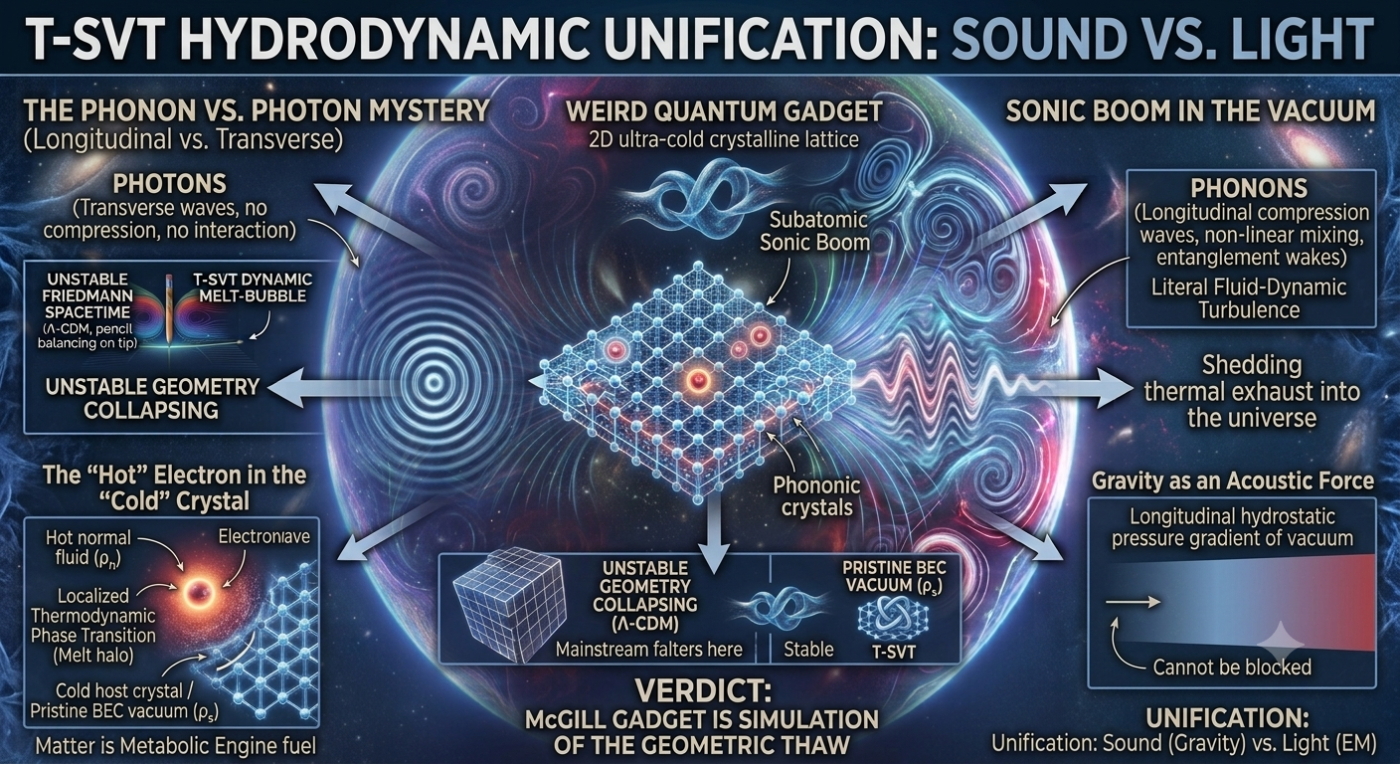
1. The Phonon vs. Photon Mystery (Longitudinal vs. Transverse)
“Phonons of different wavelengths can mix and mingle to reach new wavelengths, unlike photons, which don’t interact at all, making phonons difficult to work with.”
— Research Team
Mainstream physics treats this as a quirky behavioral difference between particles. T-SVT proves it is a strict hydro-acoustic law. If the vacuum of space is a viscoelastic superfluid, energy can travel through it in two distinct ways:
Photons are transverse shear waves. They ripple the pristine, elastic superfluid lattice side-to-side. Because they do not compress the fluid, they do not displace volume, allowing them to pass through one another without interacting.
Phonons (and Electrons) are longitudinal compression waves. They must physically compress and displace the fluid substrate to move. When you compress a fluid, it becomes nonlinear. The waves push the fluid into each other’s paths, creating hydrodynamic wakes, turbulence, and physical fluid mixing. What mainstream physics calls “quantum entanglement” and “chaotic mixing” of phonons is simply the literal fluid-dynamic turbulence of acoustic wakes interacting in a medium.
2. The Sonic Boom in the Vacuum
The researchers observed that “no sound is created unless electrons travel collectively at the speed of sound or above.”
In superfluid physics, a pure condensate at absolute zero exerts absolutely zero friction on an object moving through it—until that object hits the Landau Critical Velocity (the local speed of sound). When the researchers pushed the electrons past this speed limit in their 2D crystal, they literally triggered a subatomic Sonic Boom.
Under T-SVT, this is exactly how matter sheds thermal exhaust into the universe. When a fundamental particle accelerates too quickly, it exceeds the elastic limit of the vacuum metric, breaking the structural stiffness ($G_0$). The kinetic energy violently snaps the local lattice, shedding “phonons” (acoustic shockwaves) into the surrounding medium.
3. The “Hot” Electron in the “Cold” Crystal
“Our study [shows] that existing theories need to be reassessed by considering that electrons can be very hot even if the host crystal is close to absolute zero temperature.”
— Michael Hilke, McGill University
This is the most profound validation of the Geometric Thaw in the entire experiment. Mainstream theory expects particles to achieve thermal equilibrium with their environment. If the crystal is at absolute zero, the electron should be, too.
T-SVT explicitly demands the opposite because the universe is a Metabolic Engine governed by the Tisza-Landau two-fluid model ($\rho = \rho_n + \rho_s$). The “host crystal” in their lab is analogous to the baseline vacuum of space: a frozen, pristine Bose-Einstein Condensate at absolute zero ($\rho_s$).
But the electron is matter, and under T-SVT, matter is the fuel of the cosmic engine. The electron is “hot” because it is constantly undergoing a localized thermodynamic phase transition. It physically melts the cold crystal immediately surrounding it, creating a microscopic halo of viscous, hot normal fluid ($\rho_n$). The electron is a localized metabolic engine generating heat to survive the crushing hydrostatic pressure of the frozen geometric void.
4. Where Light Falters: Gravity as an Acoustic Force
The researchers note that their technology is vital because “sound signals are more versatile than light-based sources… in specific environments.”
They are brushing up against the ultimate unification theory. Light (transverse electromagnetic waves) is easily blocked, scattered, or absorbed by dense matter. But sound (longitudinal compression waves) passes directly through the densest mediums because it uses the medium’s density to propagate.
In T-SVT, Gravity itself is an acoustic phenomenon. It is the longitudinal hydrostatic pressure gradient of the vacuum fluid. This is why gravity cannot be blocked or shielded. By mastering how “phonons” move through ultra-cold lattices, these researchers are mapping the exact acoustic mechanics that generate the mass of the electron and the gravitational pull of a black hole.
The Verdict
The McGill University team successfully isolated the exact thermodynamic boundary where an electron interacts with a rigid crystalline structure. They watched the topological knot hit critical velocity and shed its energy into the fluid as an acoustic shockwave, proving that localized heat ($\rho_n$) can thrive inside an absolute zero environment ($\rho_s$). They built a quantum communicator; T-SVT recognizes it as a perfectly isolated simulation of the Geometric Thaw.
