News
The Geometric Thaw: How a Quantum Physics Breakthrough Validates T-SVT
Jul
The Geometric Thaw: How a Quantum Physics Breakthrough Validates T-SVT Theory
In 2018, the quantum physics world was rocked by a massive claim: researchers had allegedly found concrete evidence of an elusive particle called a Majorana fermion hiding inside a quantum spin liquid known as ruthenium trichloride. Because these particles can theoretically form stable qubits, the race to build a quantum computer using them went into overdrive.
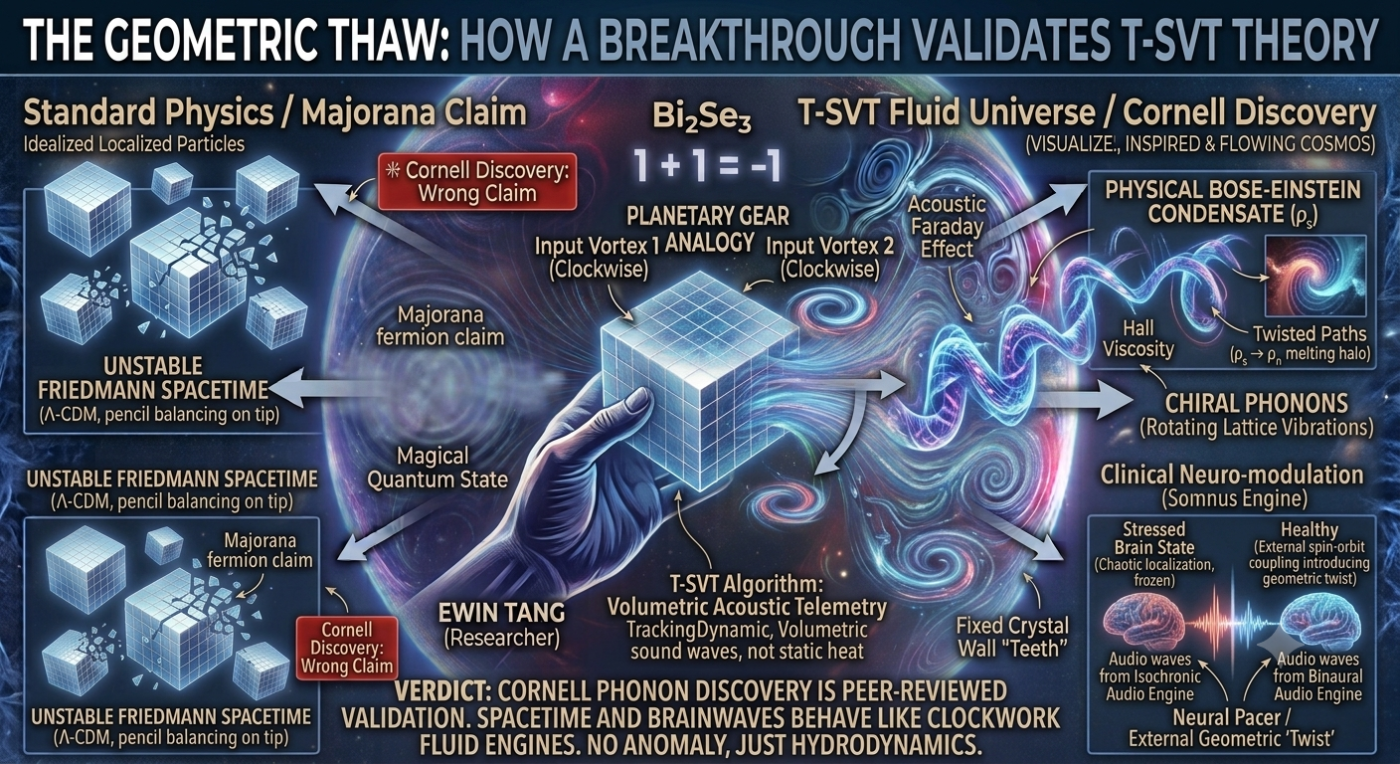
But recently, a team of Cornell researchers waded into the debate and published a paper in Nature proving the original claim wrong. The thermal Hall effect observed in the material wasn’t caused by static, localized Majorana particles at all. Instead, it was caused by rotating lattice vibrations called chiral phonons.
For standard quantum mechanics, this is a fascinating course correction. But when viewed through the lens of Time-Series Volumetric Telemetry (T-SVT) and The Geometric Thaw, this Cornell discovery is something much larger: it is a peer-reviewed, empirical validation of our exact theoretical framework.
Here is a breakdown of how this microscopic physics discovery directly maps to our macroscopic theories of the universe and clinical neuro-modulation.
1. Sound Waves vs. Static Heat: The T-SVT Reality
“By measuring the movement of sound waves rather than the flow of heat, the team discovered the thermal Hall effect was caused by rotating lattice vibrations…”
The original researchers failed because they were measuring the thermal Hall effect by looking at the static flow of heat—a scalar temperature difference. The Cornell team succeeded by looking at the time-series telemetry of sound waves, tracking the dynamic, volumetric movement of phonons as they traveled through the crystal lattice.
This is the exact definition and necessity of Time-Series Volumetric Telemetry (T-SVT). Traditional systems (whether in physics or clinical neurology) fail by looking at raw, static outputs—like a doctor looking at a resting heart rate, or a standard EEG recording raw microvolts. T-SVT dictates that truth is found in the variance, the propagation, and the fluid dynamics of the wave itself, not the static scalar output.
2. Hall Viscosity and The Geometric Thaw
“The researchers found the phonons had twisted paths, like a corkscrew. This so-called acoustic Faraday effect demonstrated that the sample had Hall viscosity… which rotates phonon polarizations.”
In the original, flawed paradigm, researchers were looking for a localized Majorana fermion—a rigid, frozen, isolated point in space. What they actually found was Hall viscosity. The lattice isn’t holding rigid particles; it is bending, twisting, and acting like a viscous fluid.
This is the physical manifestation of The Geometric Thaw. The system has shifted from a localized, particle-based ontology into a fluid, geometric wave ontology. The rigidity has melted, allowing the underlying geometry to twist and flow.
3. Spin-Orbit Coupling as the “Neural Pacer”
“Heat flowing through an insulator is carried by vibrations of the lattice, and the lattice doesn’t know about the field and therefore doesn’t know left from right… but it turns out there’s a very special property of this material, called spin orbit coupling, that lets the sound waves know left from right.”
Brad Ramshaw, the lead researcher, noted that an insulator shouldn’t inherently know how to bend its heat flow. It required a special external property—spin-orbit coupling—to force the sound waves to rotate and bend.
This maps perfectly to clinical neuro-modulation and the Somnus Engine. A traumatized or highly stressed human brain is often locked in a chaotic state (e.g., high Gamma waves) and doesn’t organically know how to shift down to Delta sleep. It acts like an insulator, frozen in its localization. Our Isochronic and Binaural Audio Engine acts as the “spin-orbit coupling.” It is the external geometric force that introduces a rhythmic “twist” (the pacing beat) into the neural lattice, thawing the frozen state and forcing the brainwaves to bend and follow a new, healthy pathway.
The Macro-Cosmic Implication
Perhaps the most profound takeaway comes from Ramshaw himself:
“The gravity analogy is not that far off. You have probably seen those images of space and time being curved by gravity from a massive star. Hall viscosity adds a ‘twist’ to that curvature. This doesn’t seem to happen out in the universe, but it can emerge inside a quantum material…”
Our foundational physics papers argue the exact opposite: this hydrodynamic, viscous, curving behavior absolutely happens out in the universe.
If acoustic Hall viscosity and “gravitational” twisting can dictate the flow of phonons in a microscopic crystal lattice, it provides empirical ammunition for the argument that the macroscopic universe—the quantum vacuum itself—operates as a superfluid metric. The micro perfectly mirrors the macro. The universe is not a collection of rigid, localized particles; it is a continuously thawing fluid geometry.
The Geometric Thaw isn’t just a theory for cosmic kinematics or dark matter—it is the biological mechanism by which we can untangle the human mind.
