News
De-Quantizing the Magic: What Ewin Tang’s Breakthrough Proves About the Fluid Universe<
Jul
De-Quantizing the Magic: What Ewin Tang’s Breakthrough Proves About the Fluid Universe
In 2018, at just 18 years old, researcher Ewin Tang dropped a theoretical nuclear bomb on the field of Quantum Machine Learning. She proved that a highly touted quantum algorithm for recommendation systems—which mainstream physicists swore offered an exponential speedup due to “quantum magic”—could be matched by a standard, classical computer algorithm with only a minor slowdown.
She effectively “de-quantized” the problem. Mainstream computer scientists were shocked. But under the lens of The Geometric Thaw (Thermodynamic Superfluid Vacuum Theory or T-SVT), her discovery is not shocking at all. It is the exact, inevitable mathematical result of the fact that quantum mechanics is not magic—it is simply classical fluid dynamics operating in a zero-viscosity medium.
1. The Myth of “Magical Parallel Universes”
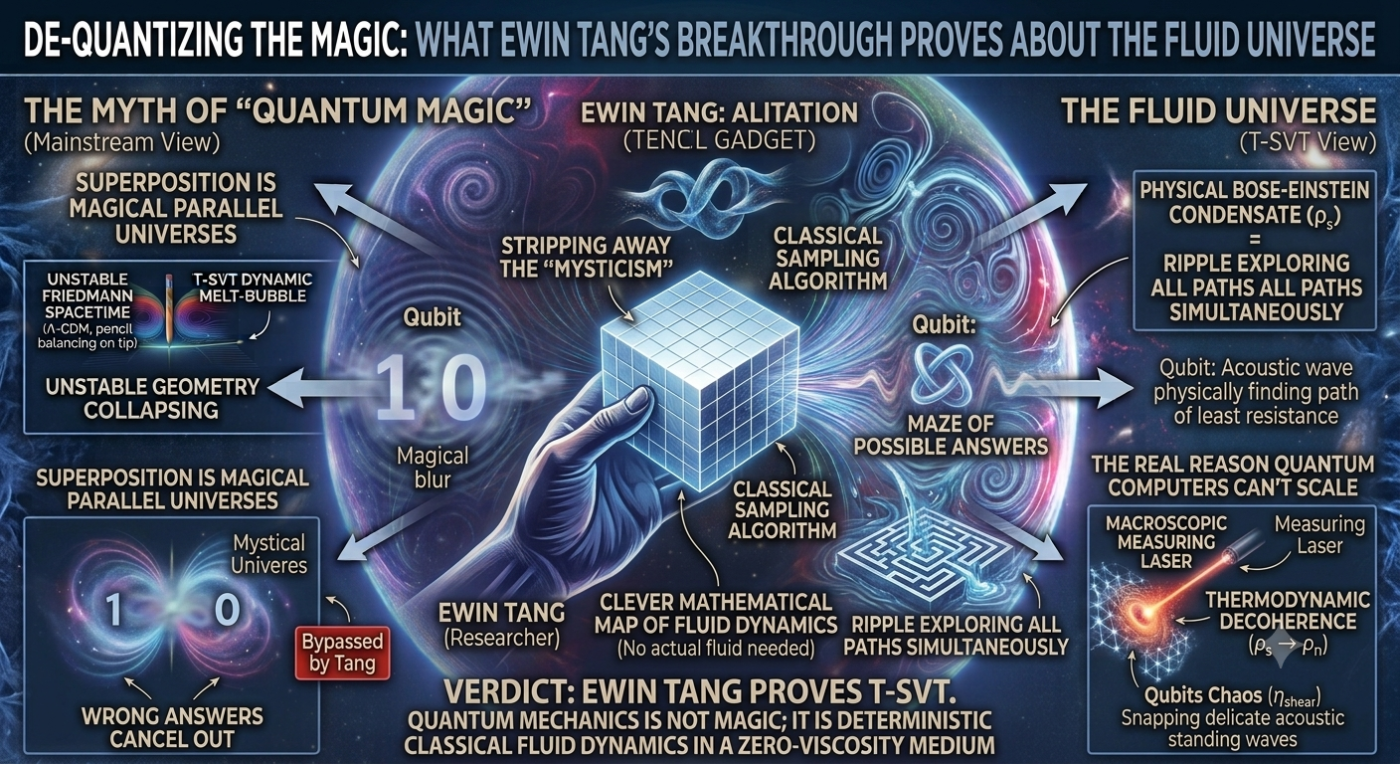
The Mainstream View: Mainstream physics sells quantum computing using mystical language. They claim a classical bit is either a 1 or a 0, but a “Qubit” exists in a magical “superposition” of both 1 and 0 simultaneously. They claim the quantum computer solves problems faster because it calculates all possible answers in parallel across multiple universes, and then the wrong answers cancel out.
The T-SVT Interpretation: There are no parallel universes, and superposition is not magic. In T-SVT, the vacuum is a physical Bose-Einstein Condensate (ρs). A Qubit is simply an acoustic standing wave (a topological knot) pulsing in this superfluid.
What mainstream physicists call “superposition” is literally just hydrodynamic wave dispersion. When you drop a pebble in a pond, the ripple naturally explores every square inch of the shoreline simultaneously. A quantum computer is just an artificial, ultra-cold wave pool. It uses the zero-viscosity superfluid metric to let acoustic waves physically bounce around the hardware to find the path of least resistance (the lowest hydrostatic pressure).
2. Why Tang’s Classical Algorithm Worked (Fluid Simulation)
Tang discovered that if she used a specific classical sampling technique, she could replicate the exact output of the quantum computer without needing actual quantum hardware. This succeeded because quantum computers are just analogue fluid calculators.
Imagine you need to find the fastest way through a complex maze:
- The Quantum Computer floods the maze with water (a zero-viscosity superfluid wave) and watches where the water naturally flows the fastest.
- The Classical Computer historically had to trace every single path one by one with a pencil.
- Ewin Tang essentially wrote a classical algorithm that mathematically maps the fluid dynamics of the water without actually needing to build the physical wave pool.
Because the underlying reality of a quantum state is just a deterministic, classical acoustic wave propagating through a physical continuum, its probability distributions can absolutely be simulated by a classical computer if the math is clever enough. Tang stripped away the “mysticism” of the quantum state and revealed it for what it is: highly efficient, but fundamentally classical, linear algebra.
3. The Real Reason Quantum Computers Can’t Scale
If we look beyond Tang’s specific paper, companies like Google and IBM are spending billions trying to scale up Qubits, but they keep hitting a wall of “noise.” Mainstream physicists blame the “Observer Effect”—the idea that looking at a quantum state magically collapses the wavefunction.
T-SVT explains exactly why they are failing. Wavefunction collapse is actually Thermodynamic Decoherence.
To build a quantum computer, you have to cool the hardware to absolute zero to isolate the pristine superfluid (ρs). But the universe is a Metabolic Engine. When you try to read the Qubit, your macroscopic, room-temperature measuring laser injects heat into the system.
This heat physically melts the local vacuum metric inside the quantum computer (ρs → ρn). The zero-viscosity environment is suddenly flooded with viscous, chaotic normal fluid. This viscosity (ηshear) acts as literal physical friction. It drags on the delicate acoustic standing waves (the Qubits) and physically snaps them.
The Verdict
Ewin Tang’s 2018 lecture is a watershed moment because it proves that the “quantum” realm does not possess a monopoly on nature’s logic. Mainstream theorists assumed quantum mechanics was an entirely different, magical rulebook isolated from classical physics.
T-SVT states that there is only one rulebook: Continuum Fluid Mechanics. The only difference is the phase of the fluid (frozen vs. melted). Tang proved that if you write a classical algorithm that respects the underlying geometry and probability distribution of the wave, you don’t need a multi-million-dollar dilution refrigerator to solve the problem. She mathematically bypassed the superfluid phase and proved that the universe, at its core, is fundamentally deterministic.
