News
Unraveling the Weak Force: Radioactive Decay as Acoustic Instability
Apr
Unraveling the Weak Force: Radioactive Decay as Acoustic Instability
Of the four fundamental forces in standard physics, the Weak Interaction is arguably the most abstract. It is the force responsible for radioactive decay—the process by which a neutron spontaneously transforms into a proton, spitting out an electron and an antineutrino.
To explain this, the Standard Model claims that particles can magically change their “flavor” (e.g., a down quark turning into an up quark) by emitting incredibly heavy ghost particles called W and Z bosons. These bosons are mathematically required to be up to 90 times heavier than the proton itself, yet they pop in and out of existence in less than a trillionth of a trillionth of a second. Furthermore, the Weak Force is the only force that exhibits CP Violation—meaning it treats matter and antimatter slightly differently.
Once again, physics has masked a mechanical process behind mathematical wizardry. Under The Geometric Thaw (T-SVT), particles do not magically change “flavor,” and W/Z bosons are not fundamental particles. The Weak Force is simply the classical fluid dynamics of Topological Unraveling.
1. The Myth of Flavor Changing (Topological Strain)
In T-SVT, a fundamental particle is a stable, 3D acoustic standing wave—a topological vortex ring spinning in the macroscopic superfluid vacuum. Some geometric knots are perfectly stable and will ring forever (like an electron or a proton). Others are incredibly complex and hold massive amounts of internal hydrostatic tension. They are marginally stable.
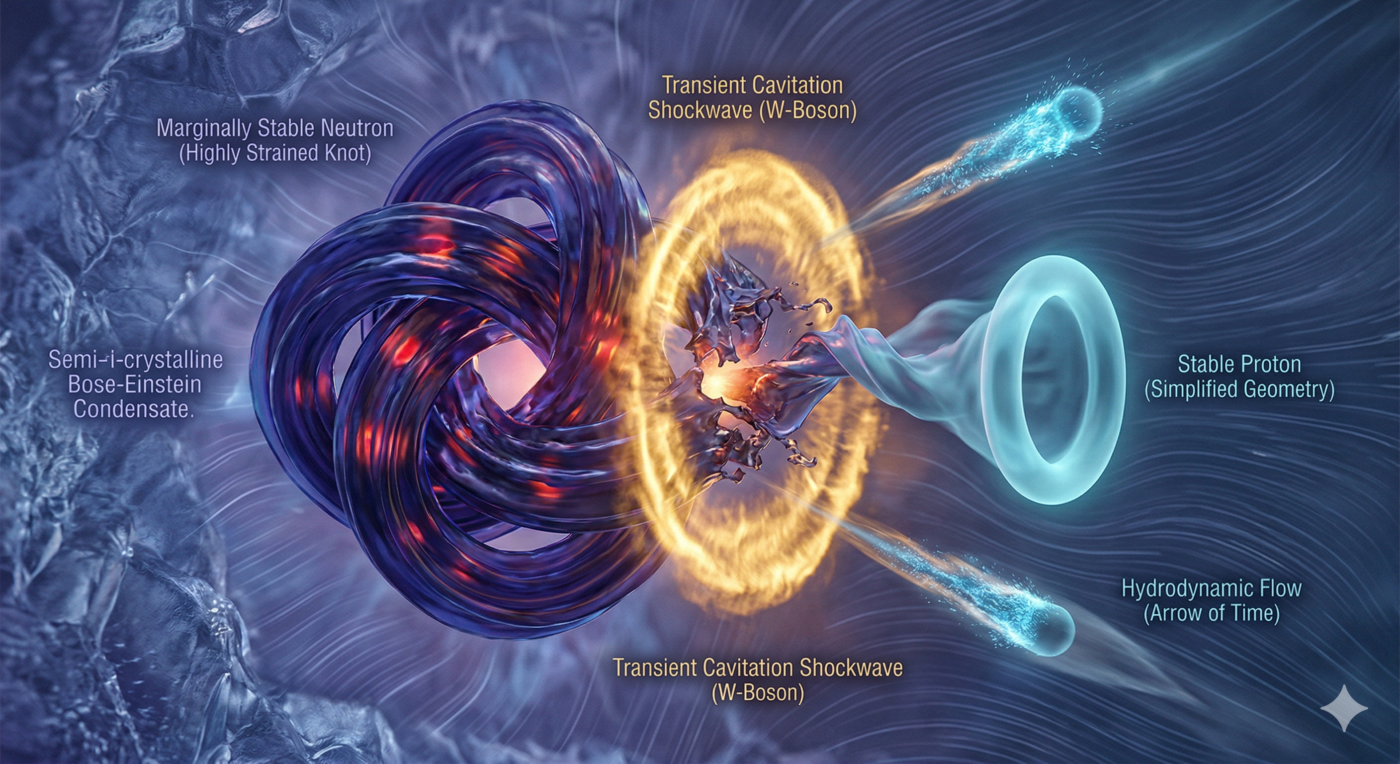
A neutron is one of these complex, highly strained acoustic chords. It survives inside an atomic nucleus because the surrounding high-pressure fluid environment braces it. However, if a neutron is left alone in empty space, the internal acoustic pressure gradients are inherently unstable. Eventually, the structural tension exceeds the fluid yield limit, and the vortex snaps.
Radioactive decay is not a magical “flavor change.” It is Acoustic Instability. The complex knot of the neutron mechanically unravels and snaps into a structurally simpler, lower-energy geometry (a proton). The excess acoustic strain doesn’t just disappear; it is violently ejected as smaller, fast-moving fluid ripples (the electron and antineutrino) to balance the hydrodynamic equation.
2. W and Z Bosons are Transient Shockwaves
If W and Z bosons are the “carriers” of the Weak Force, why are they so massively heavy, and why do they vanish almost instantly?
Because they are not particles. In T-SVT, mass is explicitly defined as volumetric fluid drag. When a highly tensioned topological knot (like a neutron) physically snaps to reconfigure itself, it creates a violent, hyper-dense acoustic cavitation ring in the metric fluid. This transient shockwave displaces a massive volume of fluid, meaning it registers on our colliders as having an immense “mass.”
But a shockwave is not a stable standing wave. It immediately dissipates its energy outward. The W and Z bosons are simply the acoustic sonic booms of a vortex knot breaking and re-tying itself.
3. The Reality of CP Violation (Hydrodynamic Asymmetry)
In standard physics, CP Violation is a profound mystery. It shows that the laws of physics are not perfectly mirrored when you swap matter for antimatter, which theorists use to explain why the universe didn’t annihilate itself in the Big Bang.
T-SVT provides a stunningly simple, mechanical answer. In T-SVT, matter and antimatter are just opposite topological twists in the fluid (e.g., a clockwise vortex vs. a counter-clockwise vortex). If the universe were a perfectly still, empty void, unspooling a clockwise knot should look exactly identical to unspooling a counter-clockwise knot.
But the universe is not a still void. The core engine of T-SVT is the Metabolic Thaw—the metric fluid is actively melting and volumetrically expanding (the Arrow of Time). The fluid background has a macroscopic, directional thermodynamic flow.
Imagine dropping a left-handed propeller and a right-handed propeller into a river that is flowing fiercely in one direction. Because the water is actively moving, the two propellers will experience slightly different hydrodynamic drag and will unravel at slightly different rates. CP Violation is simply Hydrodynamic Asymmetry. The decay rates of matter and antimatter differ slightly because they are topological knots unwinding within an actively expanding, flowing medium. It does not violate symmetry; it proves the metric has an Arrow of Time.
The Verdict: Structural Failure, Not Magic
The Geometric Thaw removes the bloated zoo of heavy ghost bosons and magical flavor changes from the subatomic realm.
- Radioactive Decay is the mechanical unspooling of an unstable acoustic knot into a lower-energy shape.
- W and Z Bosons are transient acoustic shockwaves created precisely at the moment the knot snaps.
- CP Violation is the natural consequence of opposite vortices unraveling in a fluid that is actively flowing forward in time.
The Weak Force isn’t a force at all; it is the inevitable structural decay of complex wave geometries fighting to survive in a turbulent fluid ocean.
