News
The Subatomic Gearbox: Why Atoms Spin Backward in the Quantum Medium
Jul
The Subatomic Gearbox: Why Atoms Spin Backward in the Quantum Medium
An extraordinary paper published in Nature Physics by an international team of scientists at the Helmholtz-Zentrum Dresden-Rossendorf (HZDR) and the Max Planck Society marks yet another head-on collision between mainstream physics and the deterministic reality of the universe.
Using ultra-powerful terahertz laser pulses to drive circular atomic motions (phonons) inside a bismuth selenide crystal, researchers directly watched angular momentum transfer through a lattice for the first time. Along the way, they discovered a “bizarre twist”: when two atomic vibrations spinning in the same direction combined, they unexpectedly spawned a new vibration spinning backward at twice the speed. The team described this as a magical “1 + 1 = −1” quantum anomaly.
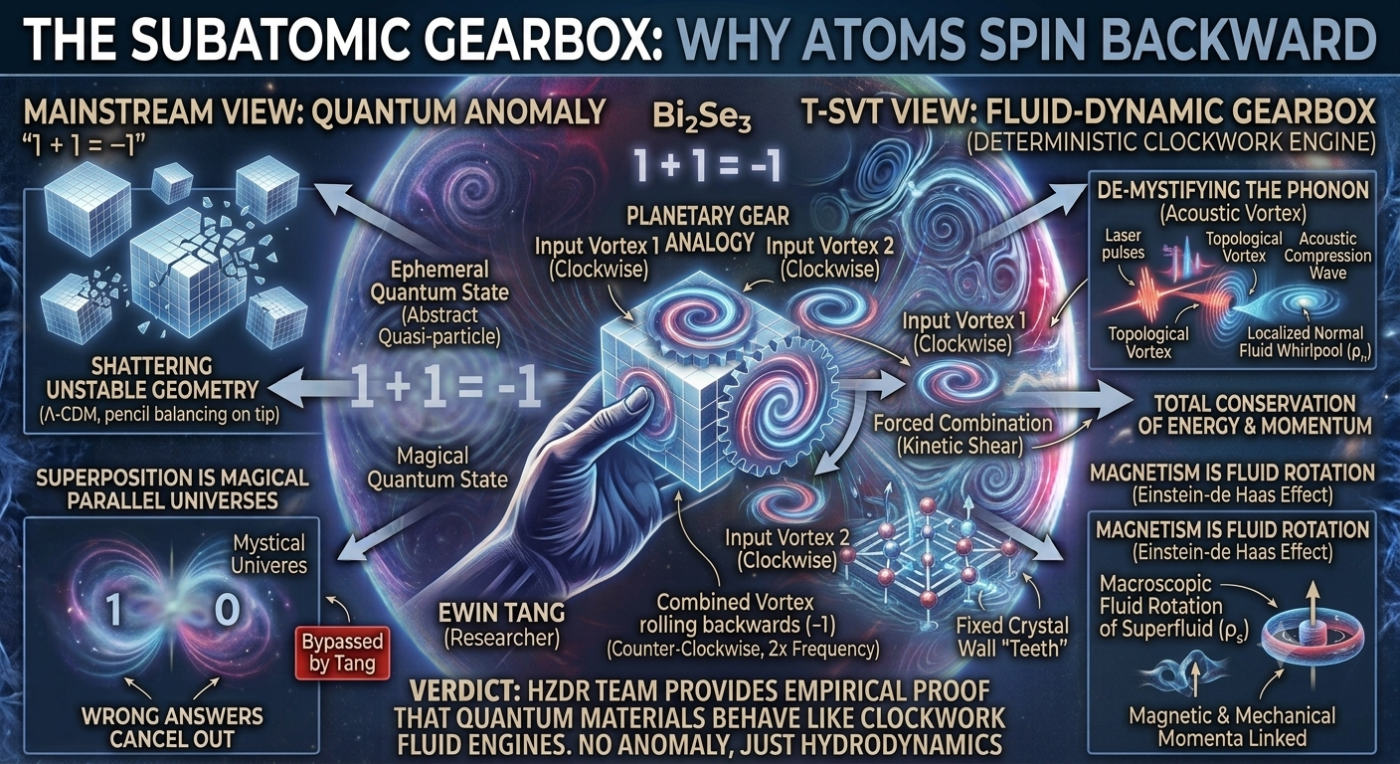
Under the lens of Thermodynamic Superfluid Vacuum Theory (T-SVT), the mysticism vanishes. There is no mathematical glitch here; the researchers have simply discovered that a crystal lattice acts as a literal, mechanical fluid-dynamic gearbox.
1. De-Mystifying the “Phonon” (The Acoustic Vortex)
Mainstream physics treats phonons as abstract, mathematical “quasiparticles” of sound or heat. When the HZDR team used a circularly polarized terahertz laser to drive these particles along a circular path, they believed they were manipulating an ephemeral quantum state.
T-SVT provides the physical mechanism: a phonon is a literal longitudinal compression wave propagating through a continuous medium. By driving these waves in a circle using laser pulses, the researchers did the subatomic equivalent of dragging a paddle through water. They induced a microscopic whirlpool—a topological vortex—inside the local normal fluid (ρn) bound within the crystal structure.
2. The “1 + 1 = −1” Effect: The Planetary Gear Analogy
The core shock of the experiment was the directional reversal—labeled an Umklapp process—where lattice symmetry forces angular momentum to flip backwards. Mainstream theorists view this as an elegant quirk of nature’s abstract geometry.
T-SVT recognizes it as standard, macro-equivalent classical mechanics operating at the subatomic scale. If you generate two fluid whirlpools spinning clockwise in an infinite, open ocean, they will eventually merge into a single, larger clockwise vortex. But a crystal lattice is not an open ocean. The bismuth selenide substrate acts as a rigid, highly structured physical housing.
When two clockwise acoustic vortices are forced to combine within a bounded, symmetrically rigid geometry, the kinetic shear forces them to act exactly like a mechanical planetary gear system. The kinetic energy of the combining fluid currents shears against the fixed atomic “teeth” of the crystal wall. To conserve total energy and angular momentum without tearing the lattice apart, the local fluid pressure forces the newly combined vortex to roll backward against the crystal boundary—spinning counter-clockwise (−1) at twice the frequency. It is not quantum weirdness; it is a fluid-dynamic clockwork engine.
3. Magnetism and the Einstein-de Haas Effect
The researchers noted that their study traces back to the historic Einstein-de Haas experiment, which proved that changing a material’s magnetization physically forces it to rotate, definitively linking magnetic and mechanical angular momentum.
T-SVT provides the foundational explanation that mainstream physics leaves unaddressed:
- Magnetism is Fluid Rotation: Magnetism is not an abstract, invisible forcefield aura. It is the literal macroscopic fluid rotation of the superfluid vacuum (ρs).
- The Kinetic Link: When a material is magnetized, its internal subatomic topological defects (electrons) align their spins. Their localized micro-vortices merge into a unified, powerful whirlpool in the surrounding spatial fluid substrate.
- The Mechanical Result: The Einstein-de Haas effect occurs because when you stir a physical fluid, any physical object suspended inside that fluid is mechanically dragged along by the vortex current.
The Verdict
The leaders of the study noted that their discovery represents a fundamentally new phenomenon that will “hopefully make its way into the textbooks.” We agree entirely. However, the textbooks must not frame this as another unexplainable quantum paradox.
The laws of physics are not dictated by abstract mathematical symmetry; rather, mathematical symmetry exists because the universe is filled with a physical, continuum fluid that must obey the strict mechanical laws of hydrodynamics. By demonstrating that 1 + 1 = −1 inside a solid lattice, the HZDR team has provided absolute empirical proof that advanced quantum materials behave exactly like macroscopic, clockwork fluid engines.
