News
The Universe Isn’t Missing 95% of Its Mass—We’re Just Misunderstanding the Medium.
Mar
For nearly a century, we have looked up at the night sky and accepted a profoundly unsettling premise: the math governing our universe doesn’t work unless we invent invisible ghosts to balance the ledger.
According to the Standard Model of Cosmology ($Lambda$CDM), the atoms that make up our bodies, our planet, and every star we can see account for a mere 5% of reality. The remaining 95% is attributed to two mysterious placeholders: Dark Matter (holding galaxies together) and Dark Energy (pushing the universe apart).
To find these missing pieces, we have spent forty years and billions of dollars building massive subterranean vats of liquid xenon (like LUX-ZEPLIN) and firing the Large Hadron Collider (LHC) at 13.6 TeV to hunt for weakly interacting massive particles (WIMPs) and supersymmetry.
The result? A deafening, continuous string of null results. The detectors are empty.
It is time to ask the hard question: What if the detectors are empty because the particles simply don’t exist? What if we aren’t missing 95% of the universe’s “stuff,” but instead, we are completely misunderstanding the physical medium in which that stuff exists?
Welcome to The Geometric Thaw.
The End of Empty Space
The greatest error in modern physics is the assumption that the vacuum of space is an empty, passive container. It is not.
The Geometric Thaw is a new, deterministic framework that proves the physical vacuum is a macroscopic, viscoelastic quantum superfluid. Space is a physical entity with measurable elasticity, shear viscosity, and thermodynamic properties.
Once we accept that space is a fluid medium rather than an empty void, the “Dark Sector” vanishes. We don’t need to invent new, invisible particles to explain the heavens; we simply need a new understanding of continuum mechanics and thermodynamics.
Redefining the “Dark” Mysteries
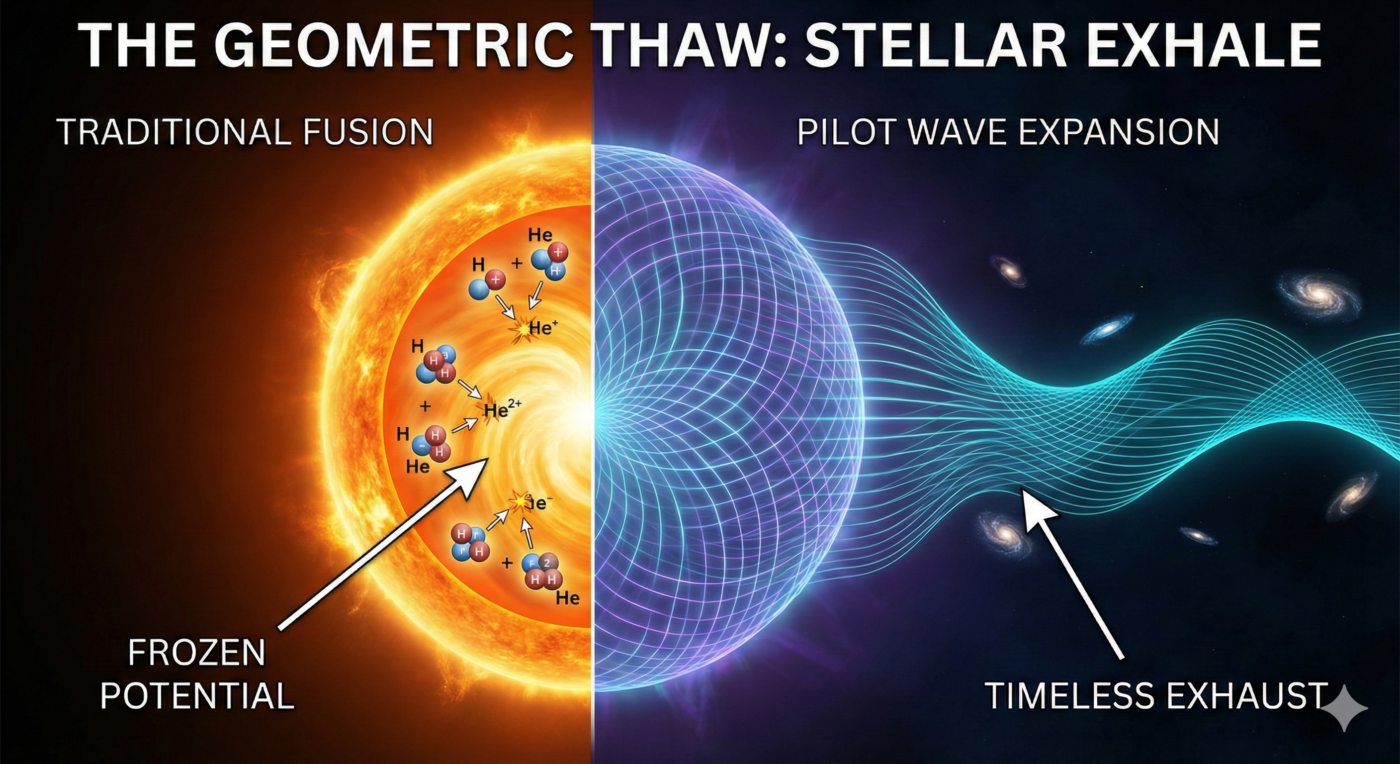
In this framework, the universe is a massive thermodynamic engine currently undergoing a systematic phase transition—graduating from a rigid, high-friction state of Frozen Potential (Matter) to a highly viscous, and ultimately zero-friction state of Timeless Kinetic (Radiation).
Here is what is actually happening in the dark:
1. Dark Matter is “Geometric Stiffness”
Dark matter is not a collisionless particle; it is the structural memory and restorative topological tension of the vacuum substrate itself.
When a massive galaxy rotates, it cannot simply spin frictionlessly through the vacuum. Because the vacuum behaves like a superfluid, the immense angular momentum of the galaxy fractures the underlying geometry, generating a dense lattice of quantized vortices. The macroscopic tension of this vortex lattice exerts an inward, $1/R$ radial pull. Space acts as a shear-thickening fluid, physically gripping the galaxy and flattening its rotation curves. We haven’t found Dark Matter particles because you cannot catch a unit of “geometric stiffness” in a particle detector.
2. Dark Energy is “Metabolic Exhaust”
The accelerated expansion of space is not driven by a mystical cosmological constant ($Lambda$). It is the thermodynamic backreaction—the metabolic exhaust—of the universe doing work.
As stars and black holes convert mass into pure radiation ($E=mc^2$), they inject intense latent heat into the underlying vacuum. This continuous thermal exhaust forces the rigid vacuum metric to locally “melt” and expand. The universe is physically expanding its volume to safely process the computational and thermal entropy of its own stellar engines. The universe isn’t expanding for no reason; it is exhaling.
The Data Speaks
This is not merely philosophical speculation. The Geometric Thaw is backed by six rigorous pillars of empirical data.
By analyzing un-smoothed data from the James Webb Space Telescope (JWST) and DESI DR1, we have already found a strict 4.15-billion-year temporal lag between the peak of stellar mass-to-energy conversion (Cosmic Noon) and the late-stage spike in cosmic acceleration. We have mapped how the shear viscosity of the “thawed” vacuum dampens the growth of the cosmic web (the $S_8$ Tension), and we have mathematically proven that the “Missing Transverse Energy” at CERN’s LHC is simply the latent heat consumed when extreme collisions locally melt the vacuum metric.
The Grand Graduation
For decades, physics has been trapped in a dying paradigm, forced to accept that the universe is winding down toward a cold, entropic heat death governed by random quantum probability.
The Geometric Thaw rejects this probabilistic surrender. The universe is not a dying clock, and nothing is truly missing. We are living inside a highly structured, deterministic thermodynamic engine that is successfully completing a pre-written geometric calculation. The “decay” of entropy is actually the mechanical evidence of our successful graduation into geometric fluidity.
The knots are untying. The friction is fading. The particle hunt is over.
Dive deeper into the math, the physics, and the six pillars of empirical proof in the newly released book, The Geometric Thaw: A Deterministic Architecture for a Fluid Universe, available now.
