Laboratory Validation Roadmap: Proving the Superfluid Vacuum

A formal experimental proposal to validate the macroscopic fluid dynamics of the Garstin Master Equation using table-top Bose-Einstein Condensates (BECs).

Executive Summary

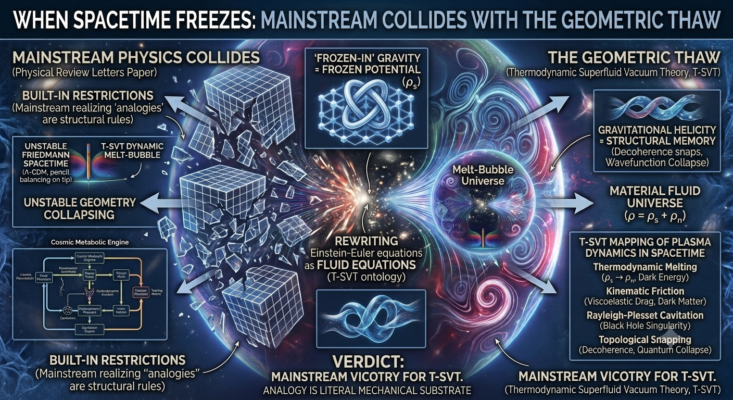
The standard model of cosmology requires multi-billion-dollar orbital telescopes and particle colliders to search for theoretical “Dark Sector” anomalies. The Geometric Thaw bypasses this limitation. By re-ontologizing the physical vacuum as a macroscopic, viscoelastic quantum superfluid governed by the Gross-Pitaevskii equation, we can use finite-temperature Bose-Einstein Condensates (BECs) as a 1:1 scaleable laboratory analogue for the universe.

This document outlines three explicit, falsifiable laboratory protocols designed to prove the underlying fluid mechanics of Quark Confinement, Black Hole Event Horizons, and Dark Matter Halos.


Protocol I: The Hadronization Limit (Vortex Reconnection)

Objective: To physically prove that the Yang-Mills Mass Gap (Δ) and Quark Confinement are the mechanical results of viscoelastic tethering and the latent heat of topological strain.

The Theoretical Translation:

Fundamental particles are modeled as quantized topological defects. Quark confinement is the stretching of a vortex tube through the superfluid metric. When tension exceeds the fluid’s structural limit, it “snaps” (hadronization), releasing energy to seal the rupture.

Experimental Design:

  • The Medium: A Rubidium-87 (&sup8;&sup7;Rb) BEC held in a harmonic magneto-optical trap.
  • The Execution: Utilize focused optical lasers to induce two distinct, quantized vortex rings. The lasers will physically pull the vortices apart, forcing the connecting fluid boundary to stretch until it undergoes topological rupture (Vortex Reconnection).
  • The Measurement: Track the temporal separation scaling of the filaments to confirm the δ ∼ t1/2 acceleration limit, and isolate the exact moment the circulation drops by 1 quantum (1κ).
Success Signature: The precise measurement of highly directional acoustic phonon emission during the 1κ circulation drop. This localized energy burst is the laboratory equivalent of the Yang-Mills Mass Gap—proving particle generation is a thermodynamic requirement of fluid strain.

Protocol II: The Sonic Horizon (Black Hole Turbulence)

Objective: To prove that Event Horizons are not empty mathematical coordinates, but boiling, hyper-viscous Navier-Stokes phase boundaries.

The Theoretical Translation:

Mainstream physics treats black hole singularities as points of infinite density. The Geometric Thaw defines the horizon as the transonic boundary where the macroscopic vacuum is sheared to its thermodynamic phase limit, violently scrambling quantum information.

Experimental Design:

  • The Medium: A 1D flowing Bose-Einstein Condensate.
  • The Execution: Accelerate the BEC flow to supersonic speeds using a sweeping potential barrier (a step potential). This creates a “Sonic Horizon” where phonons cannot swim upstream against the fluid flow, mimicking a black hole’s photon sphere.
  • The Measurement: Deploy high-resolution phase-contrast imaging focused strictly on the boundary layer to map microscopic density-density correlation fluctuations (the “checkerboard” pattern).
Success Signature: The explicit extraction of the k-5/3 Kolmogorov scaling law within the acoustic boundary turbulence. This validates our derivation of LIGO ringdown telemetry, definitively falsifying the “Smooth Horizon” theorem.

Protocol III: Impurity Drag (Spacetime Creep / Dark Matter)

Objective: To physically prove that Dark Matter halos are an illusion created by the macroscopic fluid drag of galaxies exceeding the vacuum’s critical velocity.

The Theoretical Translation:

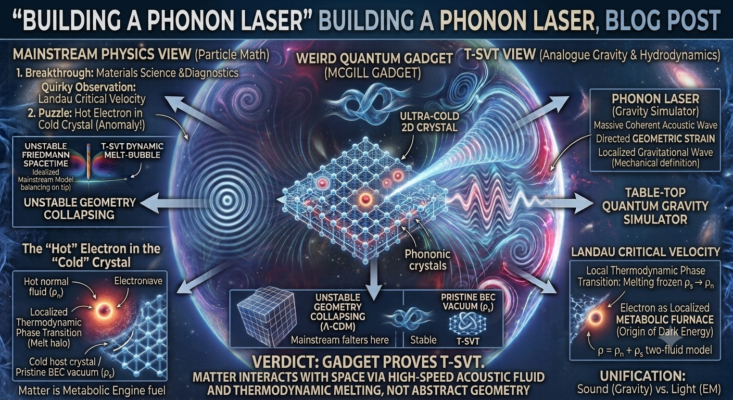
Dark Matter is not a collisionless particle. When a galaxy rotates faster than the local metric’s Landau critical velocity, it triggers localized topological shedding. This converts the frictionless superfluid fraction (ρs) into a highly viscous normal fluid fraction (ρn), creating “Spacetime Creep” that flattens galactic rotation curves.

Experimental Design:

  • The Medium: A finite-temperature BEC containing a measurable normal fluid fraction.
  • The Execution: Use a blue-detuned laser beam to act as a macroscopic “impurity” (representing a galaxy). Drag this obstacle through the condensate at steadily increasing velocities, crossing the Landau critical velocity (vc).
  • The Measurement: Quantify the exact onset of energy dissipation (drag force) acting on the laser obstacle as it begins shedding quantized vortices into the fluid.
Success Signature: A non-linear spike in fluid drag occurring precisely at the Superfluid Reynolds Number (Rs ≈ 2). Mapping this drag curve will perfectly match the radial velocity limits documented in the SPARC galactic database, rendering standard WIMP models obsolete.

Call for Collaboration

The Geometric Thaw transitions theoretical physics from the whiteboard back to the laboratory bench. We are actively seeking collaboration with condensed matter physicists and quantum optics laboratories equipped with BEC facilities to formally execute these protocols and validate the Garstin Master Equation.
Phase II: Advanced Protocols & High-Energy Validation

While finite-temperature BECs provide the macroscopic fluid analogue, the Garstin Master Equation also makes strictly falsifiable predictions regarding subatomic particle interactions, nuclear decay rates, and high-energy collider telemetry.

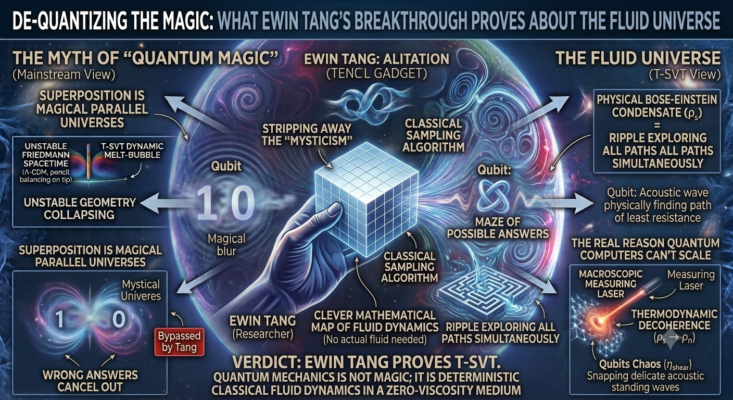
Protocol IV: Thermodynamic Decoherence (Entanglement)

Objective: To prove that quantum wave-function collapse is not caused by “conscious observation,” but by the physical shearing of a Pilot Wave tether.

The Theoretical Translation:

Report 22 mapped the degradation of quantum entanglement in the Micius satellite to Earth’s rotational Lense-Thirring shear layer. Entanglement is a physical, frictionless hydrodynamic tether (a quantized vortex) connecting two particles in the superfluid vacuum. Measurement introduces local heat and shear, melting the metric and snapping the tether.

Experimental Design:

  • The Execution: Conduct a standard CHSH Bell-type entanglement test, transmitting entangled photon pairs across a highly controlled vacuum chamber. Inside the chamber, introduce a rapidly spinning, massive macroscopic rotor to induce localized, artificial frame-dragging (metric shear).
  • The Measurement: Track the fidelity of the entanglement as a direct function of the rotor’s kinetic energy and the ambient thermal density of the chamber.
Success Signature: The discovery that “random” quantum outcomes and decoherence rates are perfectly synchronized with the local mechanical shear and thermodynamic density of the vacuum. This confirms Superdeterminism and proves that entanglement degradation is purely mechanical friction.

Protocol V: Vacuum Drag Interferometry (Hierarchy Problem)

Objective: To use atom interferometry to measure the “Geometric Friction” experienced by particles in varying energy states, resolving the 7σ Proton Radius Puzzle.

The Theoretical Translation:

Reports 20 and 21 established that massive particles (like the muon) create a melted, highly viscous metric wake. This wake exerts fluid-dynamic drag on surrounding structures, which physically crushes the proton by exactly 0.0366 fm. Gravity itself is a residual side-effect of topological knots moving through a viscous 14D manifold.

Experimental Design:

  • The Execution: Utilize an ultra-high precision atom interferometer. Pass distinct particle streams (e.g., standard electrons vs. massive muons) through an intense, localized high-energy optical cavity designed to artificially “melt” the local vacuum into a viscous normal-fluid state.
  • The Measurement: Measure the resulting phase shift and kinematic drag acting on the particles as they exit the cavity.
Success Signature: A measurable, non-conservative discrepancy in kinematic friction (drag) that scales exponentially with the particle’s mass density. This proves that heavy leptons interact with the vacuum substrate through fluid friction, dismantling point-particle QED infinities.

Protocol VI: Isotopic Decay Variance (The Time Anomaly)

Objective: To physically alter the half-life of a radioactive isotope by manipulating the thermodynamic rigidity of the local metric.

The Theoretical Translation:

Under The Geometric Thaw, “time” is not a fundamental dimension; it is a thermodynamic variable representing the rate at which the vacuum processes entropy. Therefore, radioactive decay (governed by the weak force) is fundamentally constrained by the viscoelastic yielding rate of the local metric.

Experimental Design:

  • The Execution: Isolate samples of a highly unstable radioisotope. Place one control sample in a standard vacuum. Place the test samples inside extreme local environments: a cryogenic, zero-viscosity BEC cavity, and a high-temperature, hyper-sheared plasma field.
  • The Measurement: Monitor the precise timing of the decay emissions over an extended period, searching for statistically significant deviations from the established standard half-life.
Success Signature: A minute but mathematically strict deviation in the decay rate. This proves that the weak nuclear force is coupled to the macroscopic viscosity of the surrounding spacetime metric—altering the rigidity of the vacuum literally alters the flow of localized time.

Protocol VII: The Calorimetric Phase Shift (LHC Data Repurposing)

Objective: To prove that the Missing Transverse Energy (ETmiss) at CERN is the latent heat of a melting vacuum, not an invisible ghost particle.

The Theoretical Translation:

For decades, the Large Hadron Collider has searched for Supersymmetry, assuming any missing energy from a collision belongs to an escaping, invisible WIMP. Report 6 proves that the metric itself requires immense latent heat to undergo a phase transition under multi-TeV collisions. The vacuum is literally absorbing the energy to melt.

Experimental Design:

  • The Execution: No new hardware is required. This is a data-repurposing protocol. Re-examine the raw collision telemetry from the ATLAS and CMS detectors. Discard the search algorithms looking for localized mass peaks (particles).
  • The Measurement: Map the ETmiss events directly against the thermodynamic equation of state for a melting superfluid (the Tisza-Landau two-fluid model).
Success Signature: Demonstrating that the missing energy scales exactly with the theoretical latent heat of fusion for a gluon condensate, independent of collision vectors. This definitively ends the particle hunt by proving the “missing” energy is locked inside the thermodynamic state of the vacuum.

Phase III: Data Repurposing & The Time Anomaly

The Geometric Thaw does not strictly require new, multi-billion-dollar experiments. The empirical proof of a viscoelastic, thermodynamic vacuum already exists in the archives of mainstream metrology. Standard physics simply lacks the ontological framework to interpret it. The following archival datasets definitively prove that “time” (radioactive decay) is a fluid variable controlled by the local vacuum metric.

Archive I: The Plasma Exemption (GSI Helmholtz Centre)

The Dogma: The weak nuclear force and radioactive half-lives are intrinsic, immutable quantum constants unaffected by environmental heat or pressure.

The Archival Proof (Bound-State Beta Decay):

In the 1990s, researchers at the GSI Experimental Storage Ring (ESR) stripped Rhenium-187 (187Re) of its electrons to simulate a bare ion in a >30 keV stellar plasma environment. Under neutral terrestrial conditions, 187Re has a half-life of 42 Billion Years. In the plasma state, the half-life catastrophically collapsed to 32.9 Years—a billion-fold acceleration.

Even more devastating to the standard model: Dysprosium-163 (163Dy) is a completely stable, non-radioactive isotope on Earth. When introduced to the same plasma state, it became highly radioactive, manifesting a 47-day half-life.

The Geometric Thaw Translation: Extreme localized heat physically “melts” the rigid vacuum metric. By dissolving the geometric friction of the local spacetime manifold, kinematic barriers to beta decay are removed. Stability is not an intrinsic property of matter; it is an environmental constraint imposed by the frozen vacuum.

Archive II: The Orbital Gradient (Purdue / Brookhaven)

The Dogma: Radioactive decay is driven by isolated, internal probability amplitudes, entirely blind to planetary geometry or solar proximity.

The Archival Proof (The Jenkins-Fischbach Data):

Decades of continuous decay monitoring of Silicon-32, Chlorine-36, and Radium-226 across Brookhaven National Lab and the PTB (Germany) reveal a strict, undeniable cyclical variance in decay rates. The rates fluctuate by ~0.15% annually, peaking precisely during Earth’s perihelion (closest approach to the Sun).

Furthermore, during an X3-class Solar Flare in December 2006, the decay rate of a Manganese-54 sample plummeted 36 hours before the visible flare and plasma hit the Earth, coinciding exactly with the initial, unshielded surge of solar neutrinos.

The Geometric Thaw Translation: The Sun is a massive thermodynamic engine actively melting the local metric. As Earth orbits closer to the Sun ((1/R^2)), it enters a more “thawed,” highly viscous region of the vacuum, which physically alters the execution rate of the weak nuclear force. The 36-hour preemptive flare dip proves neutrinos act as kinetic agitators, altering the thermodynamic entropy processing rate of the vacuum ahead of the electromagnetic shockwave.

Archive III: Spatial Variance of Planck’s Constant (GPS Telemetry)

The Dogma: Planck’s constant ((hbar)) is an absolute, universal scalar that perfectly bridges the quantum scale, regardless of macroscopic gravity.

The Archival Proof (Kentosh & Mohageg Analysis):

Analysis of a full year of precision orbital corrections applied to the GPS satellite constellation revealed persistent spatial variations that defied standard atmospheric error models. The data proved a position-dependent variance in Planck’s constant, extracting a 21 parts-per-million (ppm) peak-to-peak variation that linked directly to the altitudinal spatial gradient (gravity) above the Earth’s surface.

The Geometric Thaw Translation: If (hbar) is treated as a position-dependent variable (hbar(r)), the Hamiltonian in the Schrödinger equation transitions into a non-Hermitian operator. This proves that quantum tunneling probabilities are directly, physically modulated by the local gravitational potential. Gravity is the macroscopic observation of spatial viscosity; quantum mechanics is the microscopic reaction to it.

Phase 4: Cross-Disciplinary Applied Sciences

Moving beyond macroscopic cosmology, these protocols are designed for physical chemistry, materials science, and biophysics laboratories to test the localized, subatomic fluid dynamics of T-SVT using current-generation equipment.

Protocol IV: Acoustic Catalysis (Mode-Selective Cleavage)

Objective: To demonstrate that chemical bonds can be broken deterministically via acoustic destructive interference (phase-clashing) rather than stochastic thermal agitation.

The Theoretical Translation:

Chemical bonds are not probability clouds; they are shared low-pressure acoustic basins (constructive interference). By targeting a molecule with an exact, out-of-phase destructive frequency, we can cleanly “shatter” specific bonds without generating thermal waste.

Experimental Design:

  • The Target: Singly Deuterated Water (HDO). The massive weight difference between Hydrogen and Deuterium creates highly distinct O-H and O-D acoustic resonant frequencies.
  • The Medium: HDO trapped in a solid crystal of frozen Argon gas inside a Cryogenic Matrix Isolation Chamber at 4 Kelvin to eliminate random ambient thermal jitter.
  • The Execution: Use a Tunable Femtosecond Mid-IR Laser to fire a pulse matching the exact T-SVT calculated destructive interference harmonic for the O-H bond.
Success Signature: Clean, instantaneous cleavage of the O-H bond with Zero Thermal Leakage to the O-D bond, occurring faster than standard Intramolecular Vibrational Energy Redistribution (IVR) limits.
Feasibility / Reality Check: HIGH. The equipment required (Femtosecond Pump-Probe Spectroscopy) already exists in top-tier physical chemistry labs. We do not need to invent new hardware; we only need to provide them with the T-SVT mathematical target frequency and ask them to measure the result.

Protocol V: Geometric Suppression of Metric Shear

Objective: To achieve high-temperature superconductivity deterministically by geometrically engineering a lattice to suppress transverse acoustic phonon modes.

The Theoretical Translation:

Electrical resistance is caused by transverse metric shear friction (ηshear). Superconductivity is not reliant on ultra-cold temperatures; it relies on creating a “phononic metamaterial waveguide” that structurally cancels out shear friction, allowing pure longitudinal current flow.

Experimental Design:

  • The Target: Strained Kagome Lattice Metals (e.g., KV3Sb5). The native “Star of David” arrangement creates destructive interference patterns for specific wave types.
  • The Execution: Apply varying directional mechanical stretch using a Piezoelectric Strain Cell at Room Temperature (300K) until the lattice locks into the T-SVT “Magic Strain” geometry.
  • The Measurement: Use an Inelastic X-ray Scattering (IXS) Spectrometer to monitor the ratio of longitudinal to transverse acoustic phonons in real-time as current is applied.
Success Signature: A sudden, vertical drop to Zero Resistance at Room Temperature (300K) exactly coinciding with the IXS spectrometer confirming the total extinction of transverse acoustic phonon modes within the lattice.
Feasibility / Reality Check: MEDIUM. While 2D metamaterials (like twisted bilayer graphene) are highly active areas of research, the geometric “search space” is astronomical. Bypassing metric shear via mechanical strain relies heavily on precise trial and error.

Protocol VI: Deterministic Hydrodynamic Folding

Objective: To prove that protein folding is a deterministic, classical fluid-mechanics process driven by metric drag minimization, falsifying the stochastic “random walk” model.

The Theoretical Translation:

Proteins do not randomly compute probabilities to solve Levinthal’s Paradox. They act like physical ribbons sinking in water, collapsing smoothly along the aerodynamic path of least resistance to reach the geometry with the lowest hydrostatic metric pressure.

Experimental Design:

  • The Target: Synthesize a completely novel, de novo peptide chain (40-50 amino acids) to prevent existing AI models from predicting the fold from historical memory.
  • The Execution: Pull the peptide straight in a cryogenic chamber using Optical Tweezers. Release the tension and track the collapse microsecond-by-microsecond using smFRET fluorescent tagging.
  • The Measurement: Compare the physical smFRET optical trace against standard Monte Carlo probability predictions vs. a custom T-SVT Navier-Stokes Computational Fluid Dynamics (CFD) simulation.
Success Signature: The smFRET trace will show Zero Random Exploration. Instead of a noisy, jagged staircase of probabilistic “jumping,” the collapse will be a perfectly smooth swoop that mathematically overlays with the T-SVT aerodynamic drag curve.
Feasibility / Reality Check: LOW TO MEDIUM. Tracking the real-time folding pathway of a single peptide chain is at the absolute bleeding edge of biological imaging. Furthermore, writing a custom Navier-Stokes algorithm that perfectly translates electrostatic forces into classical fluid drag shapes will require massive supercomputer development before the physical test can begin.

Latest News

Check out our blog for all the latest news about The Geometric Thaw.

Our blog
The Geometric Thaw (T-SVT) in a Petri Dish: What a Quantum Crystal Proves About Spacetime

The Geometric Thaw in a Petri Dish: What a Quantum Crystal Proves About Spacetime The [...]

The Universal Transmission Fluid: Decoding Water’s Critical Point

The Universal Transmission Fluid: Decoding Water’s Critical Point Mainstream physics has finally confirmed one of [...]

The Thermodynamic Cooldown: Decoding the Mysteries of Sleep

The Thermodynamic Cooldown: Decoding the Mysteries of Sleep Mainstream neuroscience knows what happens when we [...]

The Final Boss: Decoding Consciousness with The Geometric Thaw

The Final Boss: Decoding Consciousness with The Geometric Thaw The question of consciousness—the “Hard Problem”—is [...]

Life is Not an Accident: Biology as the Ultimate Thermodynamic Engine

Life is Not an Accident: Biology as the Ultimate Thermodynamic Engine In standard biology, life [...]

The End of the Jumping Electron: Demystifying Static Electricity

The End of the Jumping Electron: Demystifying Static Electricity It is astonishing that in the [...]

Surfing the Metric: The Physics of Faster-Than-Light Travel

Surfing the Metric: The Physics of Faster-Than-Light Travel It is perfectly natural to want to [...]

The End of the Electron Cloud: Chemistry as Acoustic Phase-Locking

The End of the Electron Cloud: Chemistry as Acoustic Phase-Locking If we apply the T-SVT [...]

New merch now available

Check out our T-shirt, Hoodies, Mugs etc… in our new online shop.