News
The Illusion of Dark Energy: How Fluid Stability Overthrows Modern Cosmology
Jul
A staggering mathematical checkmate has just been dealt to mainstream cosmology. In a new paper published in the Proceedings of the Royal Society, mathematician Blake Temple and his team at the University of California Davis have delivered formal, rigorous proof that the standard model of cosmic expansion (\(\Lambda\)-CDM) is fundamentally unstable.
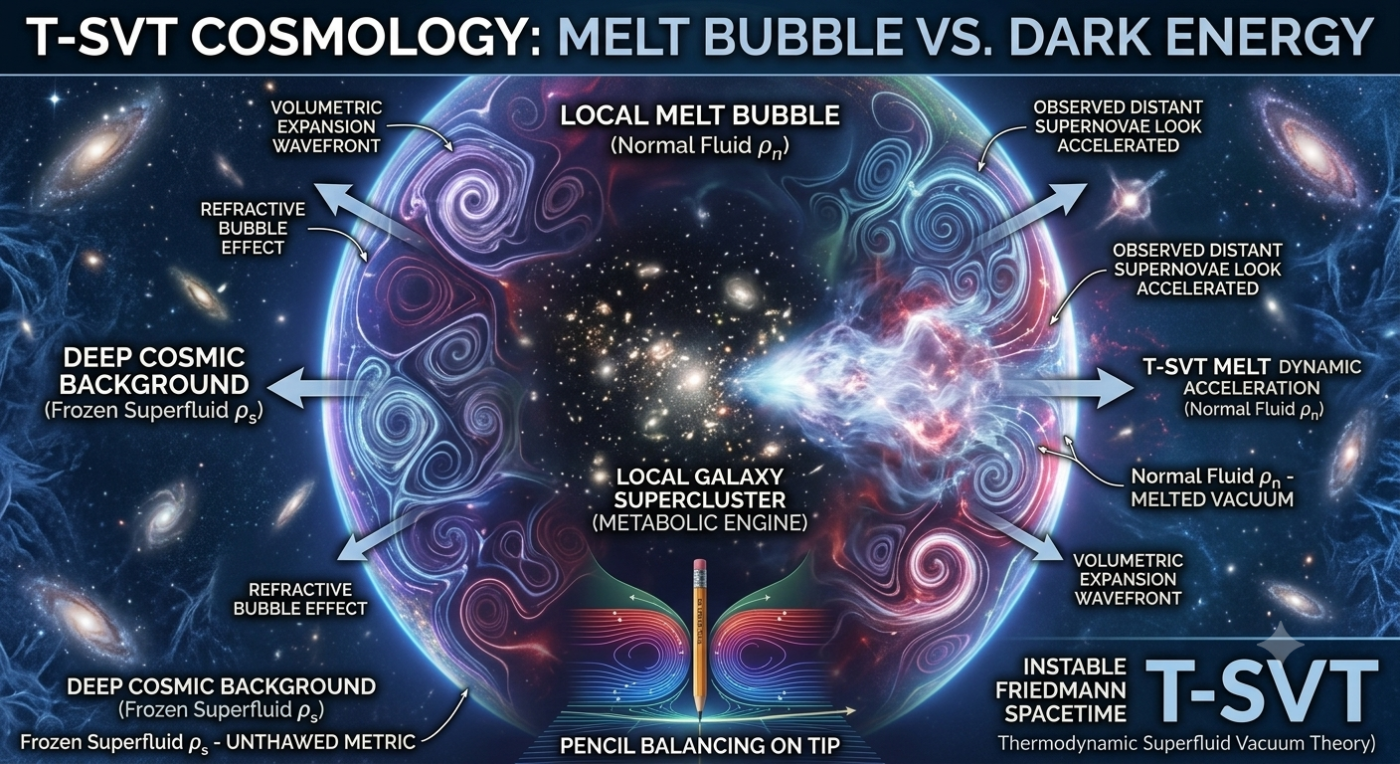
For nearly thirty years, dark energy has been treated as an undeniable cornerstone of cosmology. When astronomers in the 1990s observed that the universe was accelerating outward, they invented an invisible, anti-gravitational pressure built into the empty vacuum of space to balance the books. However, Temple’s team has proven that this uniform framework is as physically impossible as a pencil perfectly balancing on its sharp tip forever. The moment the pencil experiences the slightest disturbance, it topples.
Under the lens of Thermodynamic Superfluid Vacuum Theory (T-SVT) and The Geometric Thaw, this discovery is a historical milestone. It mathematically dismantles the abstract geometric vacuum and forces cosmology to reckon with the material physics of a fluid universe.
1. The Collapse of Friedmann Spacetimes
The standard model of cosmology relies entirely on Friedmann spacetimes, a mathematical shortcut that assumes all matter and energy are perfectly ground up and distributed completely smoothly across the universe.
Temple’s team has shown that this smooth uniformity is radically unstable across both large and small scales. In real-world physics, an unstable solution is deemed “unphysical”—meaning it is an idealized math equation that can never actually survive contact with reality.
T-SVT explains exactly why this framework fails: Space is not an empty, mathematical coordinate system; it is a physical, viscoelastic fluid medium (\(\rho = \rho_s + \rho_n\)). A real, material fluid can never be perfectly uniform. It is constantly subjected to localized density fluctuations, acoustic pressure waves, and thermal variations. Trying to model the cosmos using a perfectly smooth Friedmann spacetime is like trying to model the Atlantic Ocean by assuming it has no waves, currents, or temperature changes. It is a blackboard fantasy.
2. Dark Energy is the Kinetic Footprint of the Thaw
The most fascinating revelation in the UC Davis paper is that when you strip away the unstable assumption of uniform expansion, cosmic acceleration does not vanish. Instead, the acceleration falls naturally out of Einstein’s original field equations without any need to bolt “Dark Energy” onto the side of the math.
Mainstream physicists are stunned by this, but T-SVT reveals the exact physical mechanism driving it: The expansion of our universe is a localized, thermodynamic phase change.
The baseline universe is a frozen, ultra-ordered Bose-Einstein Condensate (\(\rho_s\)). But the universe behaves as a Metabolic Engine. Every star that ignites, every black hole that compresses, and every galaxy that rotates acts as a localized furnace. They radiate thermal exhaust, physically melting the pristine, frozen vacuum into a viscous, thermal normal fluid (\(\rho_n\)).
When a solid substance like ice melts into liquid water, it undergoes a massive volumetric expansion. The universe is not being pushed apart by an invisible phantom (“Dark Energy”). The universe is accelerating because it is physically melting. The volumetric swelling of the vacuum metric as \(\rho_s\) converts into \(\rho_n\) is the acceleration. By calculating the math of an uneven, non-uniform universe, Temple’s team has mapped the turbulent wavefronts of this cosmic phase transition—The Geometric Thaw.
3. Smashing the Copernican Principle: The Local Melt Bubble
The study highlights an “awkward” problem for the establishment: both Temple’s stable mathematical alternative and the raw astronomical data require us to occupy a “special position” in the universe. This directly cuts against the Copernican Principle—the long-cherished assumption that our corner of space is exactly like every other corner.
T-SVT removes this awkwardness completely. We do not occupy a spiritually sacred center of the universe; rather, we occupy a Local Melt Bubble.
- High Density Thawing: Our local supercluster of galaxies is an incredibly dense, energetic hub of matter. Consequently, our region of space has undergone a much higher degree of “thawing” (\(\rho_n\)) than the vast, empty cosmic voids outside of us.
- Refractive Fluid Index: When we look out from inside our warm, melted bubble into the freezing deep space beyond, the light from distant supernovae passes through a profound fluid boundary.
- The Bubble Effect: The expansion rate looks radically accelerated to us not because we are the center of creation, but because we are looking out through the glass walls of an expanding thermodynamic bubble into the dense, frozen Arctic of the deep cosmic background (\(\rho_s\)).
The Verdict
Did we invent Dark Energy for nothing? Yes. Dark Energy was a mathematical ghost conjured to protect a deeply flawed model of an empty, uniform universe. The moment you treat the universe as localized, complex, and dynamic, space accelerates on its own. Space does not need a mystical energy source to grow; it simply obeys the fundamental laws of thermodynamics and fluid mechanics. The standard model is a pencil toppling over; T-SVT is the fluid substrate that catches it.
