News
The Geometric Thaw (T-SVT) in a Petri Dish: What a Quantum Crystal Proves About Spacetime
Apr
The Geometric Thaw in a Petri Dish: What a Quantum Crystal Proves About Spacetime
A recent breakthrough by researchers at KAIST and Stanford University has captured the scientific community’s attention. Using 4D scanning transmission electron microscopy, they watched electrons organize themselves inside a quantum material—and the picture was far messier than mainstream physics expected.
The researchers observed Charge Density Waves (CDWs)—repeating patterns of electronic order—forming and breaking apart across a phase transition. What they found was startling: the order did not form uniformly. It formed in scattered patches. Even more surprising, small pockets of this order persisted above the transition temperature, stubbornly refusing to melt.
Mainstream physicists view this as a curious anomaly in solid-state materials. But when viewed through the lens of Thermodynamic Superfluid Vacuum Theory (T-SVT), this paper ceases to be just about a niobium diselenide crystal. It becomes a direct, benchtop observation of the vacuum of spacetime itself freezing and thawing.
1. The Patchy Vacuum: Visualizing the Two-Fluid Model
The KAIST team noted that electronic order forms in scattered patches, resembling a lake freezing unevenly rather than covering the surface all at once.
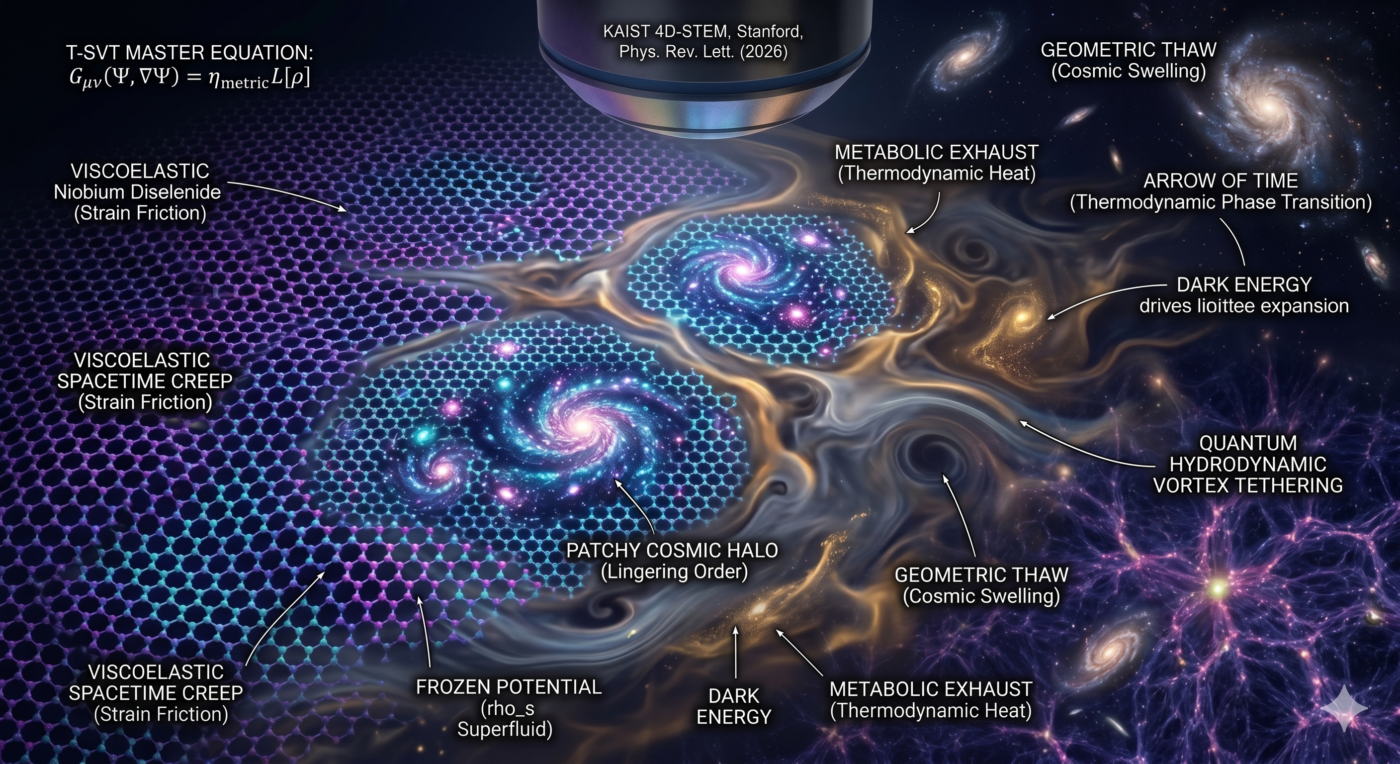
Under T-SVT, the vacuum of space is not an empty void; it is a macroscopic Bose-Einstein Condensate governed by the historic Tisza-Landau two-fluid model ($ \rho = \rho_n + \rho_s $). What the researchers actually observed is the precise, localized tug-of-war between the frozen, pristine superfluid state ($\rho_s$) and the melted, viscous normal fluid state ($\rho_n$).
Because the universe is a Metabolic Engine, thermal exhaust is never perfectly uniform. Therefore, the spatial metric does not crystallize or thaw everywhere simultaneously. The “electrons” in this experiment are not independent billiard balls; they are acoustic standing waves acting as tracer dye, revealing the underlying patchy substrate. The ordered patches represent localized regions of Geometric Stiffness, while the blank patches are pools of melted, viscous metric.
2. Lattice Strain as Viscoelastic Decoherence
“Even minute amounts of strain… were enough to significantly weaken the CDW amplitude. This strong link between strain and electronic order provides direct evidence that subtle lattice distortions play a crucial role…”
— KAIST Research Team
In standard quantum mechanics, wave-function collapse is often treated as a mystical, probabilistic event. In T-SVT, it is pure fluid-dynamic determinism, defined as Thermodynamic Decoherence.
T-SVT defines space by topological strain, where physical friction acts against structural deformation. The “minute strain” applied by the KAIST researchers is literal, physical shear stress introduced into the superfluid. By straining the lattice, they introduced mechanical friction. The acoustic standing waves (electrons) were physically dampened by the induced shear viscosity of the medium. The quantum order didn’t just probabilistically vanish; it was hydrodynamically dragged to death by the structural strain of its environment.
3. Pockets of Order Above Transition: Cosmic Hysteresis
Perhaps the most profound discovery was that small pockets of order persisted even above the transition temperature ($T_c$). The electronic order didn’t vanish instantly; it gradually lost spatial coherence.
This is direct, microscopic proof of Viscoelastic Hysteresis—the property of a fluid to retain “memory” of its previous state. In a standard ideal gas, crossing a critical temperature causes an instant state change. But a viscoelastic superfluid resists the thaw. When the KAIST team raised the temperature, the global topological mold broke down, but isolated “knots” of the frozen state stubbornly survived in the boiling, higher-entropy environment.
The Cosmological Implication: If we scale this benchtop phenomenon up, it perfectly explains the macro-structure of the cosmos. As the early universe expanded and thawed from its initial ultra-dense state, it did not thaw evenly. It left behind massive, lingering pockets of un-thawed, frozen spatial order. What mainstream astrophysics calls “Dark Matter halos” may actually be exactly what KAIST observed: massive, surviving patches of frozen metric floating in the vast, expanding sea of our thawed, viscous universe.
The Grand Synthesis
The standard physics community looks at this KAIST paper and sees a curious anomaly in solid-state physics. Through the lens of The Geometric Thaw, this experiment is a benchtop simulation of the universe itself.
It proves that a finite-temperature quantum medium does not obey idealized, frictionless mathematics. It is messy, it suffers from physical shear friction, it thaws in fractal patches, and it possesses deep, structural memory that outlasts thermodynamic phase transitions. The vacuum is not a stage; it is a working, viscoelastic fluid engine.
