News
The Hydrodynamics of Zero Thermal Expansion
Jul
A recent milestone published in Nature Chemistry has demonstrated Isotropic Zero Thermal Expansion (ZTE) across an unprecedented structural window spanning from \(11\text{ K}\) to \(893\text{ K}\). The material system, a sodalite-cage crystal framework comprised of \(\text{Cd}_4\text{Al}_6\text{O}_{12}\text{SO}_4\) (CASO), defies classical lattice expansion profiles. Standard condensed matter frameworks attribute this performance to fractional atomic occupancy and highly coordinated structural disorder. However, a comprehensive analysis under Thermodynamic Superfluid Vacuum Theory (T-SVT) shifts the paradigm from mechanical lattice constraint to localized hydrodynamic and acoustic equilibria within the underlying quantum superfluid substrate.
1. The Superfluid Viscoelastic Stress Balance
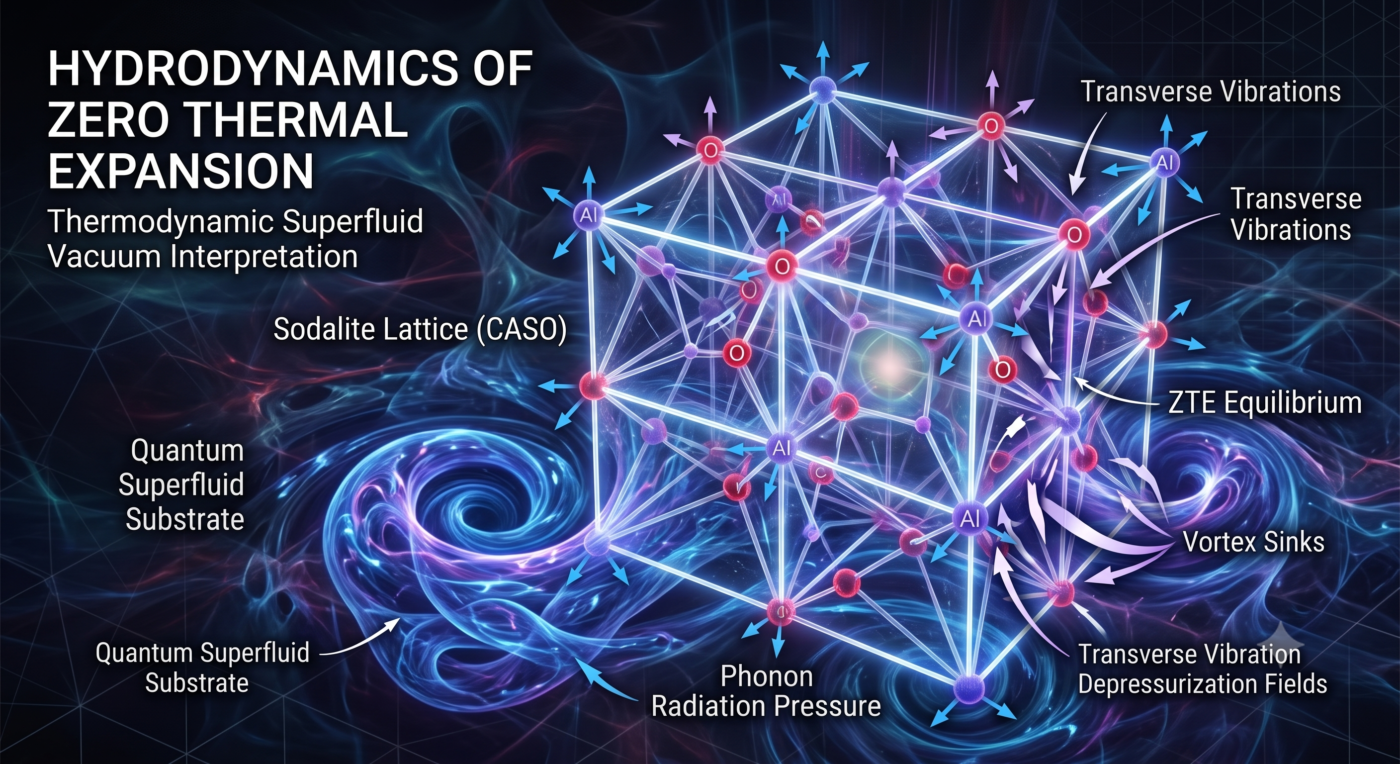
Within the framework of T-SVT, solid atomic configurations are not treated as isolated masses suspended in an empty void. Instead, stable baryonic matter manifests as localized, tightly bound, knotted vortex topologies embedded within a non-zero viscosity quantum superfluid vacuum undergoing continuous thermal phase transitions. When external thermal energy is introduced to a typical lattice, the propagation of high-frequency thermal phonons manifests as an increase in local acoustic radiation pressure along the superfluid channels separating atomic cores. This localized pressure differential pushes adjacent vortex nodes apart, yielding macroscopic positive thermal expansion (PTE).
In the unique CASO sodalite configuration, the engineered fractional atomic occupancy introduces a highly optimized structural acoustic baffle. Because specific atomic sites within the cage remain vacant or partially occupied, the lattice forms an interlocking array of flexible, non-dissipative micro-cavities. This prevents the immediate, linear propagation of phonon-driven acoustic radiation pressure, shielding the macroscopic framework from early-stage expansion strain.
2. Transverse Vibrations as Hydrodynamic Sinks
A central feature of the CASO structure is the intense excitation of transverse vibrational modes (TVMs) by the bridged oxygen atoms perpendicular to their principal bond axes. In traditional materials science, these vibrations pull the terminating atoms closer together, producing a geometric contracting force known as negative thermal expansion (NTE).
When re-interpreted through T-SVT, these high-energy transverse oscillations operate directly as localized hydrodynamic vortex sinks and acoustic shear-wave pumps. As the temperature rises toward \(893\text{ K}\), the open, flexible boundaries of the sodalite cage allow the transverse oxygen oscillations to generate local depressurization fields within the underlying superfluid medium. Rather than expanding outward, the surrounding quantum vacuum substrate experiences an inward flow towards these localized shear zones, generating a continuous mechanical tension that balances the normal repulsive forces of the atomic cores.
3. Isotropic Equilibrium and Chiral Stability
Because the CASO framework crystallizes in a perfectly symmetrical cubic arrangement, this hydrodynamic pressure balancing act is completely isotropic. Across the entire thermal continuum from cryogenic baselines to extreme high-temperature environments, the outward acoustic radiation pressure and the inward superfluid depressurization remain locked in a precise, self-regulating equilibrium.
Engineering Implications for Non-Dissipative Computing
This structural balancing strategy offers a critical design principle for alternative hardware architectures. By mapping partial atomic vacancies and fractional occupancy lines into thin-film integrated circuits (such as lithium niobate acoustic platforms), we can guide transverse acoustic shear waves to naturally neutralize thermal expansion stress, ensuring absolute geometric stability for sub-micron component tolerances.
4. Concluding Analysis
The realization of a continuous zero thermal expansion state up to \(893\text{ K}\) validates the hypothesis that localized geometry can alter the hydrodynamic properties of the vacuum substrate itself. By treating the CASO crystal not merely as an assembly of chemical bonds, but as a complex acoustic guide for the viscoelastic superfluid vacuum, future material design can purposefully manipulate the local field gradients of the vacuum to achieve completely invariant physical properties across extreme environmental ranges.
