News
The Fluid-Dynamic Cosmos: How the Einstein-Euler Equations Rule Out Dark Energy
Jul
A profound mathematical breakthrough published in the Proceedings of the Royal Society A by researchers at UC Davis has provided the heavy mathematical artillery needed to dismantle the standard Lambda-Cold Dark Matter (\(\Lambda\)-CDM) model of the universe.
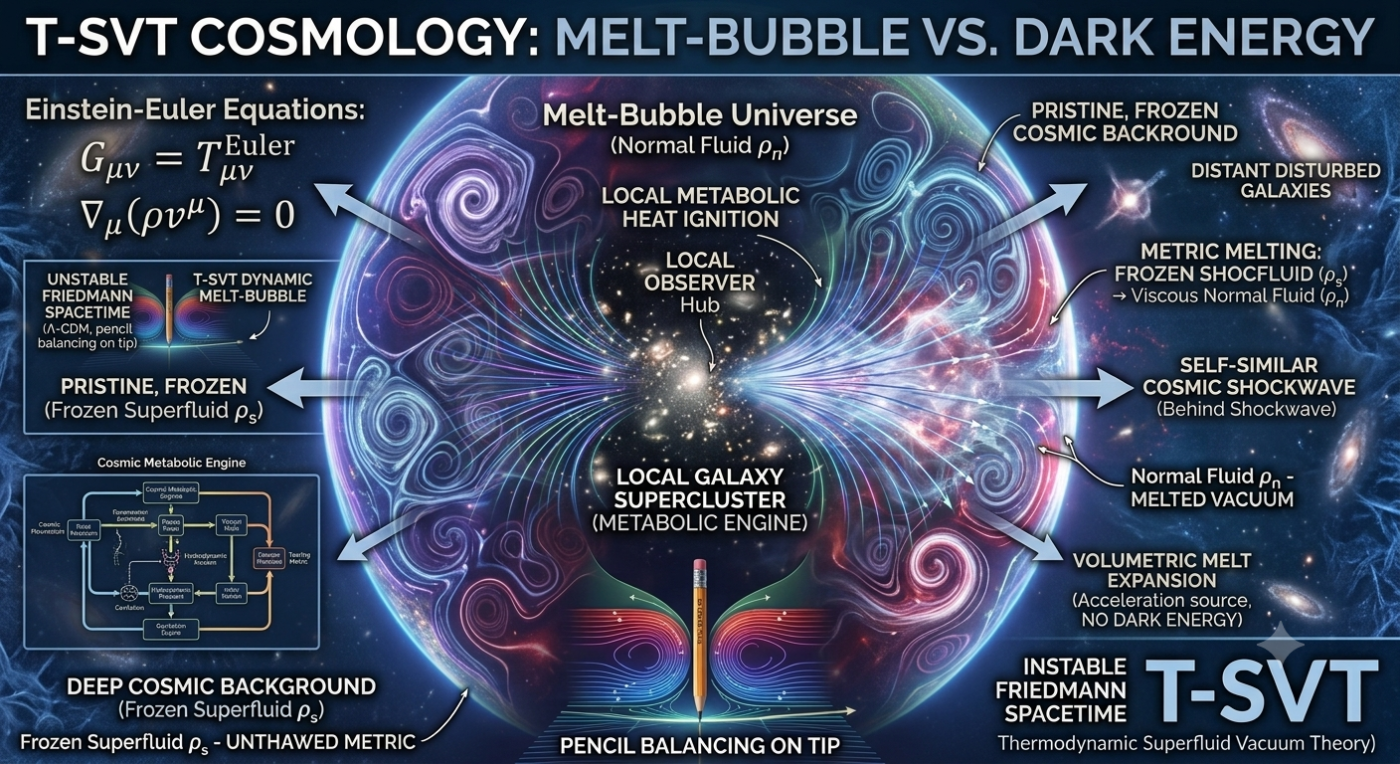
By mapping cosmic expansion through the Einstein-Euler equations, the team has proven that the uniform, idealized models governing modern cosmology are inherently unstable and physically non-viable. Like a pencil balanced precariously on its tip, any minute perturbation causes the standard model to fall away.
To mainstream astrophysics, this is an elegant mathematical critique. But under the lens of Thermodynamic Superfluid Vacuum Theory (T-SVT) and The Geometric Thaw, these findings provide direct mathematical validation that space is a material fluid medium, and that cosmic acceleration requires no “dark energy” ghost in the machine.
1. The Einstein-Euler Equations: Space as a Fluid Continuum
The Einstein-Euler equations represent a direct mathematical marriage between General Relativity and Fluid Dynamics. Standard astrophysics treats this framework as an approximation—a handy tool for modeling how gas clouds move through an empty spacetime container.
T-SVT flips this paradigm completely. The reason the Einstein-Euler equations model the universe flawlessly is because the container and the fluid are the exact same entity. The vacuum metric is a physical, viscoelastic fluid continuum (\(\rho = \rho_s + \rho_n\)). Euler’s equations govern the hydrodynamics of momentum and mass, while Einstein’s equations govern the resulting geometry. Combining them mathematically acknowledges that cosmic space is directed by physical fluid pressures, shear stresses, and localized density variations.
2. Collapsing the Rest Point (The Dynamic Phase Portrait)
The UC Davis team utilized a self-similar version of these equations to characterize the standard model as a “rest point” in a mathematical phase portrait. They proved that Friedmann spacetimes are radically unstable to radial perturbations at large scales, forcing the system to violently diverge away from equilibrium.
In the language of T-SVT, this unstable rest point represents a state of perfect, static equilibrium: a completely uniform, undisturbed, frozen superfluid vacuum (\(\rho_s\)). The mathematics prove this state cannot survive contact with reality. The localized thermal ignition of the first stars and galaxies acts as a thermodynamic trigger. This metabolic heat introduces a radial perturbation that forces the pristine, frozen rest point to collapse. The space fluid begins to melt, dynamically rushing away from equilibrium along the divergent trajectories mapped in the team’s phase portrait. That rush away from frozen stability is the accelerated expansion we observe.
3. The Self-Similar Cosmic Shockwave
Corresponding author Blake Temple revealed their fundamental insight: “Our first idea was that maybe the universe was expanding because there was a shockwave, and the anomalous acceleration was the expanding wave behind that shockwave.”
This is the literal smoking gun of The Geometric Thaw:
- The Thermal Rupture: The Big Bang was not an explosion of nothingness; it was a cataclysmic, localized thermal rupture in an infinite, crystalline superfluid medium.
- The Expanding Wavefront: This rupture generated a massive, self-similar, expanding thermodynamic shockwave.
- The Mechanism of Acceleration: Behind this shockwave front, the frozen vacuum (\(\rho_s\)) is actively tearing, cavitating, and melting into the viscous normal fluid (\(\rho_n\)). The universe is not being pushed apart by an invisible dark energy factor; it is being driven by the physical hydrodynamic pressure gradient running directly behind the expanding wavefront of the Thaw.
4. Resolving the Copernican Crisis
The mathematical proofs indicate that while the Big Bang should look uniform and Friedmann-like near the center of symmetry, observers must generically witness sharp accelerations far from that center. The team notes this calls into question the Copernican principle (the idea that our position in the cosmos is unremarkable).
T-SVT perfectly resolves this without invoking cosmic teleology. If you sit near the origin point of a massive detonation inside a fluid, the medium immediately surrounding you appears relatively calm, uniform, and symmetrical. However, as your gaze travels outward toward the boundaries of the blast, you hit the highly accelerated, turbulent pressure gradients of the outward-rushing shockwave.
We do not occupy a divinely privileged center. We simply reside deep within the interior core of a massive, localized thermodynamic melt-bubble. Near our core, the fluid looks homogeneous. But as our telescopes peer into deep space, they are looking directly at the non-uniform, highly accelerated outer edge of the fluid shockwave where the metric is aggressively tearing into the frozen deep background.
The Verdict
By using the Einstein-Euler equations to prove that a uniform universe is a physical impossibility, the UC Davis team has stripped cosmology of its mysticism. They have shown that when space is treated as a complex, non-uniform fluid system, acceleration is mandatory and dark energy is zero. The universe does not require a mystical energy source to grow; it is simply a colossal, self-similar hydrodynamic wave rippling through a physical continuum.
